

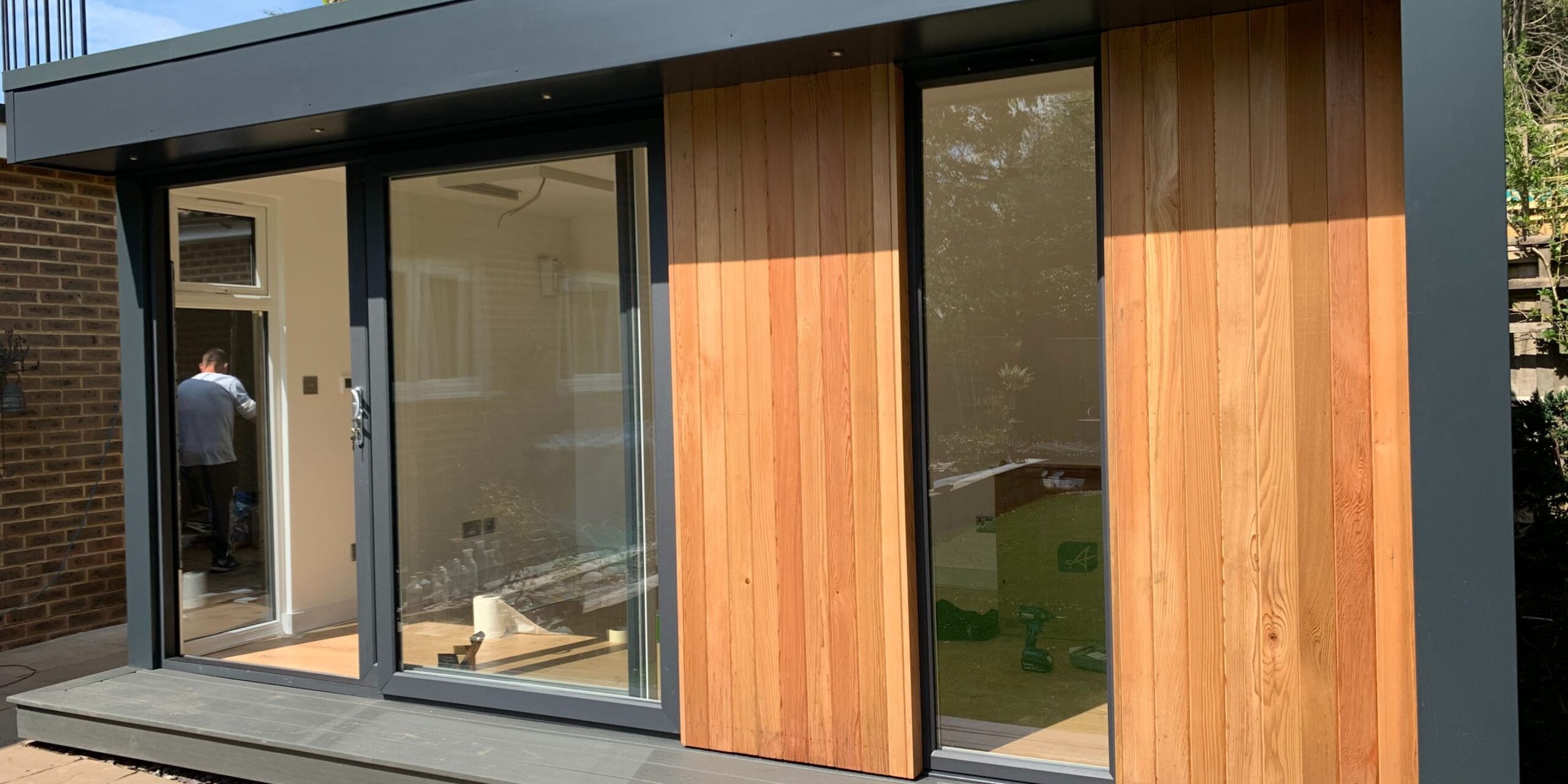
Around 40 per cent of British workers now spend at least part of their week working from home. That figure has held steady since 2023, and most forecasters expect it to stay there through 2026 and beyond. If you are one of the millions balancing laptop work with family life, kitchen noise, and the pull of the sofa, a garden office room gives you something a spare bedroom rarely can: a proper workplace with a front door you close behind you at the end of the day.
We have been building garden rooms across South East London, Kent, Surrey, and Sussex since 2004, with over 1,000 completed projects. A large proportion of those builds are garden office rooms for remote and hybrid workers, and the demand has only grown. Here is what you need to know before you invest.
Why a Garden Office Room Changes the Way You Work
Working from home sounds ideal until you are three months in and cannot separate your work life from your personal life. Research consistently shows that the biggest challenge for remote workers is not productivity but boundaries. A 2025 ONS survey found that 78 per cent of remote workers report improved work-life balance, yet many of those same respondents struggle with “switching off” when their office is also their living room.
A garden room office solves this by creating genuine physical separation. You walk out of your home, across the garden, and into a dedicated workspace. When the day is done, you lock up, walk back, and you are home. That short commute, even if it is only fifteen metres, resets your brain in a way that closing a laptop on the kitchen table never will.
This is not just anecdotal. Studies on remote work productivity show that dedicated home offices outperform shared or temporary workspaces. When Stanford researchers examined hybrid working patterns, they found that workers with proper dedicated spaces maintained productivity levels equal to their in-office colleagues. Those working from sofas and dining tables showed measurably lower focus and higher stress.
The Practical Requirements for a Year-Round Garden Office
A garden office room needs to function as a real workplace, not a summer house you tolerate in winter. Here is what separates a proper home office garden room from an overpriced shed.
Insulation That Keeps You Comfortable in Every Season
This is the single most important specification. Cheap garden buildings use 25mm or 50mm polystyrene panels and call themselves “insulated.” That is not enough. You will spend a fortune on electric heaters in January and still feel the cold through the walls.
All of our garden office rooms use 100mm PIR (polyisocyanurate) insulation in the walls, floor, and roof. PIR is one of the most thermally efficient insulation materials available, with a lower U-value than mineral wool at the same thickness. At 100mm, the insulation far exceeds what budget garden buildings offer, keeping the room warm in winter and cool in summer with minimal heating costs. Most of our customers find a small electric panel heater is all they need, even in the coldest months.
Electrics Done Properly
Every garden office room needs mains power. That means an armoured cable run from your consumer unit to the building, buried 500mm to 750mm deep with warning tape above it, and installed by a qualified electrician under Part P of the building regulations. Inside the room, you will want plenty of double sockets (we recommend at least six), dedicated lighting circuits, and ideally a small consumer unit within the garden room itself.
Our builds include full electrical installation as standard, so you are not left arranging a separate electrician after handover.
Internet Connectivity You Can Rely On
Do not assume your home Wi-Fi will reach a garden office room. Insulated walls, double glazing, and distance all weaken the signal. For reliable video calls and file transfers, you have three good options: a wired ethernet connection run through conduit alongside the power cable (the best option), a dedicated Wi-Fi access point mounted in the garden room, or a mesh network system that extends coverage from the house. Plan this before the build. Running ethernet after the cable trench is filled costs significantly more.
Ergonomic Workspace Design
Under the Health and Safety (Display Screen Equipment) Regulations 1992, employers have a legal duty to assess and manage risks for employees who use screens daily for an hour or more, whether they work in a corporate office or a garden room. This means your garden office room should accommodate a proper adjustable desk and chair, a monitor at the correct height, and good natural and artificial lighting.
The advantage of a garden room office over a spare bedroom is space. Even our Midi (4.0m x 3.0m) provides 12 square metres of floor space, which is more than enough for a full-size desk, office chair, storage, and a small seating area for breaks. Larger rooms like the Maxi (5.0m x 3.5m) give you 17.5 square metres, room for a meeting area or standing desk alongside your main workstation.
Choosing the Right Size Garden Office Room
Size matters more than most people realise. Too small and you feel cramped within a month. Too large and you have wasted money and garden space. Here is how our range matches up to different working needs.
Midi: 4.0m x 3.0m
The Midi is our most popular garden office room for single-person use. At 12 square metres, it comfortably fits a large desk, ergonomic chair, bookshelf, and a small armchair or sofa for reading breaks. If you work alone and do not need space for client meetings, this is likely all you need.
Maxi: 5.0m x 3.5m
The Maxi gives you 17.5 square metres. This is the right choice if you regularly have video calls (a separate background wall and better camera angles), want a standing desk alongside a seated desk, or occasionally have a colleague visit to work alongside you. Many of our customers who run small businesses choose this size.
Multi: 6.0m x 4.0m
At 24 square metres, the Multi is a genuine two-person office or a generous single-person workspace with room for a meeting table, storage, and a breakout area. It suits professionals who see clients at home, couples who both work remotely, or anyone who needs space for specialist equipment like design rigs or recording setups.
Multi+: 7.0m x 4.5m
The Multi+ at 31.5 square metres is our largest standard size. This is a proper commercial-grade home office with room for multiple workstations, a meeting area, storage, and even a small kitchenette if needed. If you are running a business with employees or need a studio space, the Multi+ handles it without feeling cramped.
Not sure which size suits your situation? We also design bespoke garden rooms to exact specifications, so you are not forced to choose from fixed sizes if your garden or working needs call for something different.
Does a Garden Office Room Add Property Value?
Yes, and the numbers are encouraging. Estate agents consistently report that a quality garden office room can add between 5 and 15 per cent to a property’s value. On a home worth £400,000 in South East London or Kent, that is a potential uplift of £20,000 to £60,000.
Rightmove has tracked a significant increase in property listings mentioning garden offices over the past decade, and agents say that buyers in 2025 and 2026 actively search for homes with dedicated garden workspaces. The key word is “quality.” A well-insulated, professionally built garden office room with electrics, internet connectivity, and good finishes adds genuine value. A sagging flat-pack shed with an extension lead running to it does the opposite.
Our garden rooms are built with a 50-plus year lifespan and backed by a 10-year warranty. When a surveyor inspects the property, they see a permanent, high-quality structure, not a temporary outbuilding that will need replacing in a few years.
Tax Considerations for Your Garden Office Room
The tax position depends on your employment status and how you use the room. Here is a straightforward summary, though we always recommend speaking to an accountant for advice specific to your situation.
If You Are Self-Employed or Run a Limited Company
The cost of the garden office building itself is not tax deductible as an expense. HMRC classifies it as a structure, which is a capital item. However, everything you put inside the room qualifies for capital allowances: furniture, computers, monitors, lighting, shelving, and even thermal insulation materials. Running costs including electricity, heating, business rates (if applicable), and a proportion of your home internet bill can also be claimed as business expenses.
If the garden office has its own electricity meter, 100 per cent of those electricity costs may be claimable. Without a separate meter, you would claim a reasonable proportion based on usage.
If You Are Employed
HMRC tax relief for working from home is more limited for employees. You can only claim if your employer requires you to work from home and has no office available for you to use. Voluntarily choosing to work from home, even with your employer’s agreement, does not qualify. The standard flat rate relief is £6 per week without needing to provide evidence, or you can claim the actual additional costs if they are higher.
Capital Gains Tax: A Point to Be Aware Of
If you use part of your property exclusively for business, that portion may not qualify for Principal Private Residence Relief when you sell. In practice, most garden office users also use the room for personal purposes occasionally, which normally avoids this issue. But it is worth discussing with your accountant, especially if you plan to sell within a few years of building.
Planning Permission and Building Regulations
Most garden office rooms fall under permitted development, meaning you do not need planning permission. The main conditions are that the building must be single storey, must not cover more than 50 per cent of the garden, and must not exceed 2.5 metres in height if within two metres of a boundary. Our standard builds are designed to stay within these limits.
If your property is in a conservation area, is a listed building, or has specific planning conditions, different rules may apply. We handle the planning side for every project and will tell you upfront if permission is needed. You can read more on our planning permission and building regulations page.
What Our Garden Office Rooms Include as Standard
Every garden office room we build comes with:
- 100mm PIR insulation in walls, floor, and roof for genuine year-round comfort
- Double glazed windows and doors for thermal efficiency and noise reduction
- Full electrical installation including multiple sockets, lighting, and consumer unit
- Plastered and painted interior ready to furnish and use from day one
- Insurance-rated locks and toughened glass for security
- 10-year warranty on the structure, with a 50-plus year expected lifespan
We build every garden room with our own team. We do not use subcontractors. That means consistent quality and a single point of contact from the first conversation through to completion.
How to Get Started
If you are ready to stop working from the kitchen table and set up a proper garden office room, the process is straightforward. Browse our full range with prices to find the right size and specification, then get in touch to book a free consultation. We will visit your property, discuss your working needs, advise on the best position and size, and give you a clear, fixed quote with no hidden extras.
We cover South East London, Kent, Surrey, and Sussex, and most builds are completed within two to three weeks of the start date.
Save £5,000 with Our Ambassador Programme
Want a quality garden office room for less? Our Ambassador Programme offers a £5,000 saving on your build. In return, you allow us to photograph the completed garden room and host a small number of viewing visits for prospective customers. It is a straightforward arrangement that has helped hundreds of our customers get more garden room for their budget.