

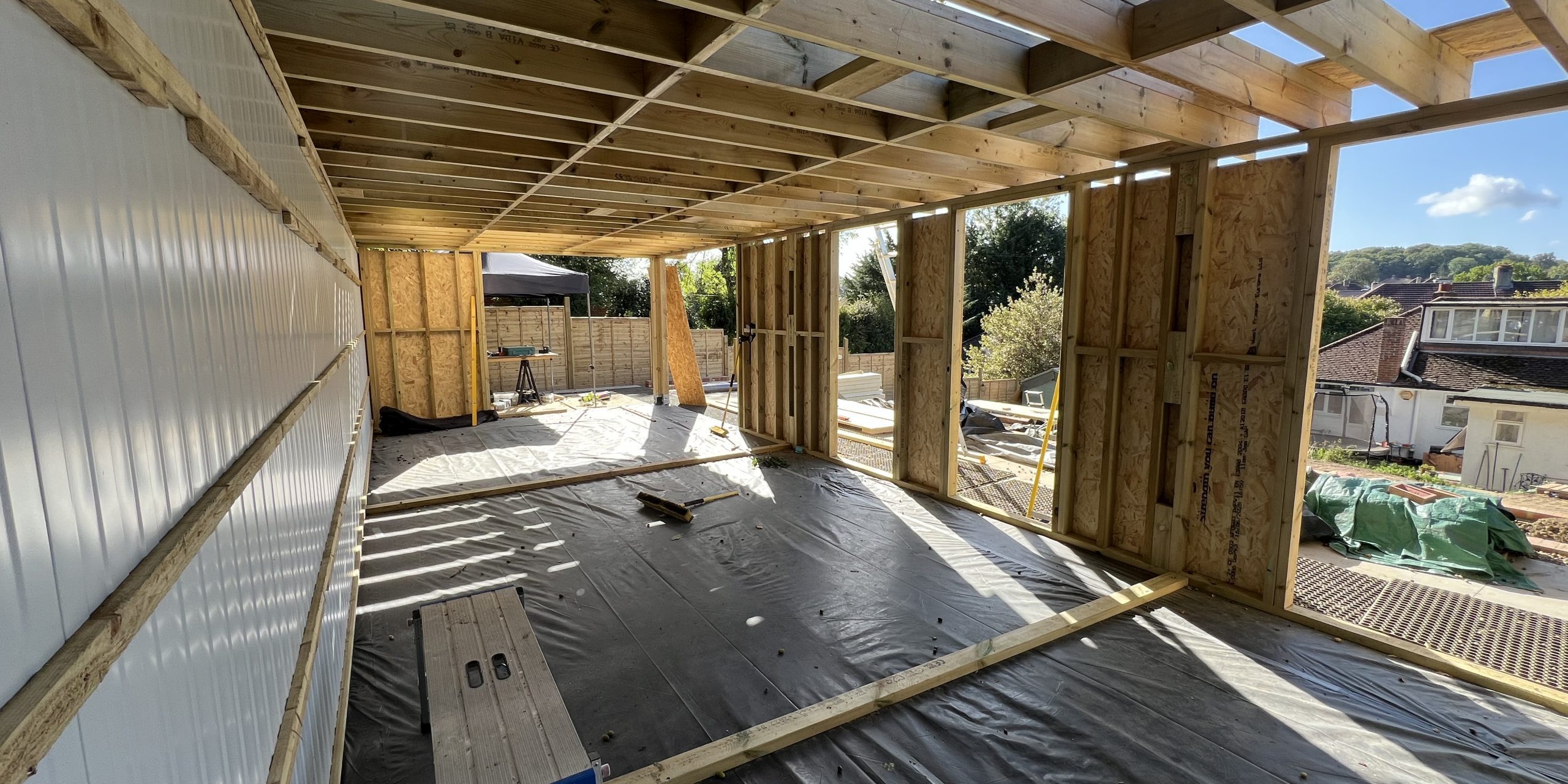
You can build a garden room right up to your boundary fence, provided the total height does not exceed 2.5 metres. If you want a taller building, you must keep it at least 2 metres from the boundary. That is the short answer. The longer answer involves building regulations, fire safety, the Party Wall Act, drainage, and a few practical considerations that most articles overlook. We have dealt with all of these on over 1,000 builds since 2004 across South East London, Kent, Surrey, and Sussex, so here is everything you actually need to know.
The Core Garden Room Boundary Rules Under Permitted Development
Garden room boundary distance is governed by Class E, Schedule 2, Part 1 of the Town and Country Planning (General Permitted Development) (England) Order 2015. This is the legislation that gives you permitted development rights to build an outbuilding without submitting a planning application, as long as you follow the rules.
The height restrictions work like this:
- Within 2 metres of any boundary: The maximum overall height of the building is 2.5 metres. This applies regardless of roof type. No part of the structure can exceed 2.5 metres.
- More than 2 metres from any boundary with a dual pitched (apex) roof: Maximum overall height of 4 metres, with eaves no higher than 2.5 metres.
- More than 2 metres from any boundary with any other roof (flat, mono-pitch): Maximum overall height of 3 metres, with eaves no higher than 2.5 metres.
So the garden room boundary distance question really comes down to height. A 2.5 metre tall garden room can sit directly against the boundary. A taller one needs the 2 metre gap.
Why “Garden Room 2m From Boundary” Is the Most Common Setup
Most purpose-built garden rooms, including all of ours, are designed to sit just under 2.5 metres in total height. This is not a coincidence. At 2.5 metres you get a comfortable internal ceiling height of around 2.3 to 2.4 metres while staying within the boundary limit. It means you can place the building wherever it works best in your garden without worrying about the 2 metre setback.
That said, there are situations where a customer wants a garden room 2m from the boundary with a taller roof, perhaps to accommodate a vaulted ceiling or extra headroom for a specific use. This is perfectly achievable under permitted development, but the 2 metre gap must be measured carefully.
Where Do You Measure From?
This is where people often get caught out. The 2 metre distance is measured from the legal boundary line of your property to the nearest point of the building. Two important details here:
- The boundary line is not necessarily your fence. Fences are sometimes positioned a few inches inside the true boundary, or they may have shifted over the years. If you are relying on the 2 metre rule, check your title deeds or the Land Registry plan to confirm where your actual boundary sits.
- The nearest point includes overhangs. Roof overhangs, fascias, soffits, and guttering all count. If your garden room wall is 2.05 metres from the boundary but the roof overhang brings it to 1.95 metres, you are within 2 metres and the 2.5 metre height cap applies. We design our buildings with this in mind, keeping overhangs tight so they do not eat into your usable setback distance.
Building Regulations and the 1 Metre Boundary Rule
Permitted development and building regulations are two separate systems, and they have different boundary rules. Even if your garden room does not need planning permission, you may still need to think about building regulations depending on size and position.
Here is how it works:
- Under 15 square metres internal floor area: Building regulations do not normally apply (assuming no sleeping accommodation). You can build right up to the boundary.
- Between 15 and 30 square metres: Building regulations do not normally apply, provided there is no sleeping accommodation AND the building is either at least 1 metre from any boundary or constructed from substantially non-combustible materials.
- Over 30 square metres: Full building regulations approval is required regardless of position.
The fire safety logic behind the 1 metre rule is straightforward. A timber-clad building sitting right on the boundary could allow a fire to spread to the neighbouring property. If your garden room is between 15 and 30 square metres and you want it within 1 metre of the boundary, the external walls facing the boundary need to be built from non-combustible materials, such as cement board cladding rather than timber.
Our Midi (4.0m x 3.0m, 12 sq m) falls under the 15 square metre threshold, so it can be placed right on the boundary without triggering building regulations. Our Maxi (5.0m x 3.5m, 17.5 sq m) and larger models fall into the 15 to 30 square metre band, so if you want one of these within 1 metre of the boundary, we account for the fire safety requirements in the design.
The Party Wall Act and Garden Rooms
The Party Wall etc. Act 1996 is a separate piece of legislation that many garden room buyers overlook. It applies when you are building near your neighbour’s property and can require you to serve formal notice before starting work.
There are two scenarios where it might apply to a garden room build:
Building a New Wall on or at the Boundary Line
If your garden room wall sits directly on the boundary line (not just near it, but actually on the line), you may need to serve a Party Wall notice on your neighbour. This requires at least one month’s written notice before work begins. In practice, most garden rooms are positioned at least a small distance inside the boundary, which avoids this trigger.
Excavation Near Your Neighbour’s Structures
Section 6 of the Act covers excavation within 3 metres of a neighbouring building or structure. If your garden room foundations will involve digging within 3 metres of your neighbour’s house, extension, or even a substantial outbuilding, and the excavation goes below the level of their foundations, you need to serve notice at least one month before starting.
The 6 metre rule is stricter still: if you are excavating within 6 metres and the dig would meet a 45-degree line drawn downwards from the base of your neighbour’s foundations, notice is also required. This typically only applies to deep basement-style foundations, not the shallow pad or screw pile foundations used for garden rooms.
Most garden room foundations are relatively shallow, so the Party Wall Act is rarely triggered. But if your garden is tight and your neighbour’s house or extension is close, it is worth checking. Getting this wrong can lead to an injunction that stops your build entirely.
Eaves, Gutters, and Overhanging the Boundary
No part of your garden room should overhang the boundary line into your neighbour’s airspace. Under English law, a property owner has rights over the airspace above their land. Any overhang, even a gutter or fascia board just a few centimetres over the line, technically constitutes a trespass.
In practice, a court might consider a small gutter overhang a trivial matter and decline to order its removal. But your neighbour could also ask you to cut it back, and they would be within their rights. It is far better to avoid the situation entirely by keeping every element of the building within your own boundary.
This is another reason why the measurement from the nearest protruding point matters. When we design a garden room for a position close to a boundary, we factor in the full depth of the roof overhang, guttering, and any downpipes to make sure nothing crosses the line.
Drainage and Rainwater Runoff
A garden room placed close to the boundary creates a new roof area that sheds rainwater. You have a legal responsibility to manage that water on your own land. Allowing roof runoff to drain onto your neighbour’s property is not treated the same as natural rainfall running downhill across a lawn. Roof water collected by gutters and downpipes must be directed to a soakaway, drainage channel, or surface water drain within your own boundary.
If your garden room is positioned right against the boundary, the guttering on the boundary side needs to be carefully designed so that water is collected and routed away without spilling over. This is a standard part of our installation process, but it is worth knowing about if you are comparing different suppliers.
Practical Considerations Beyond the Legal Rules
The law might allow you to build right up to the boundary, but there are practical reasons to leave a gap.
Maintenance Access
Once a garden room is built tight against a fence, you cannot get behind it to paint, repair cladding, clean gutters, or replace the fence itself. We generally recommend leaving at least 300 to 500 millimetres on any side that is close to a fence or wall. This gives enough room to squeeze in with a paintbrush or reach up to clear a gutter.
Construction Access
Our installers need working space around the building during construction. A minimum clearance of about 400 millimetres is needed on all sides for assembly and safe working. If one side is completely against the boundary, construction becomes significantly harder and may require removing fence panels temporarily (with your neighbour’s agreement).
Neighbour Relations
A 2.5 metre high wall right on your boundary will change the feel of your neighbour’s garden, even if it is perfectly legal. Having a conversation with your neighbour before you build costs nothing and can prevent months of friction. In our experience, most neighbours are fine with it once they understand what is being built and can see the design. The ones who cause problems are usually the ones who were not told until the builders turned up.
Ground Conditions
If the boundary area has poor drainage, heavy tree roots, or sloping ground, positioning the garden room further into your own garden may give you a better foundation and a drier building in the long term.
Conservation Areas, Listed Buildings, and Other Restrictions
All of the garden room boundary rules above assume your property has full permitted development rights. There are situations where the rules are tighter:
- Conservation areas, National Parks, AONBs, and World Heritage Sites: You cannot place an outbuilding to the side of the house. Buildings more than 20 metres from any wall of the house are limited to 10 square metres.
- Listed buildings: Any outbuilding in the curtilage of a listed building requires planning permission and listed building consent. Permitted development does not apply.
- Article 4 directions: Your local council may have removed specific permitted development rights in your area. This is common in parts of South East London and some Kent towns.
If any of these apply to you, get in touch with us and we can advise on the planning application process. We handle these regularly.
Summary: Garden Room Boundary Distance at a Glance
- A garden room up to 2.5 metres tall can be built right up to the boundary (subject to building regulations fire rules for buildings over 15 sq m).
- A garden room taller than 2.5 metres must be at least 2 metres from any boundary.
- Distance is measured from the legal boundary to the nearest part of the building, including roof overhangs and gutters.
- The boundary line is not always where the fence is. Check your title deeds if you are relying on the 2 metre rule.
- The Party Wall Act may apply if you are building on the boundary line or excavating near your neighbour’s structures.
- Roof drainage must be managed on your own land.
- Leave 300 to 500mm for maintenance access where possible.
For most gardens, a well-designed garden room at 2.5 metres high will fit comfortably close to the boundary without any planning complications. Our full range, from the compact Midi to the spacious Multi and Bespoke options, is designed to work within these rules. Take a look at our buildings and prices to see what suits your garden.
Save £5,000 with Our Ambassador Programme
Want to save on your garden room? Our Ambassador Programme knocks £5,000 off the price. In return, we use your build for photography and arrange a handful of viewing visits for prospective customers. It is a straightforward deal that works well for both sides.