

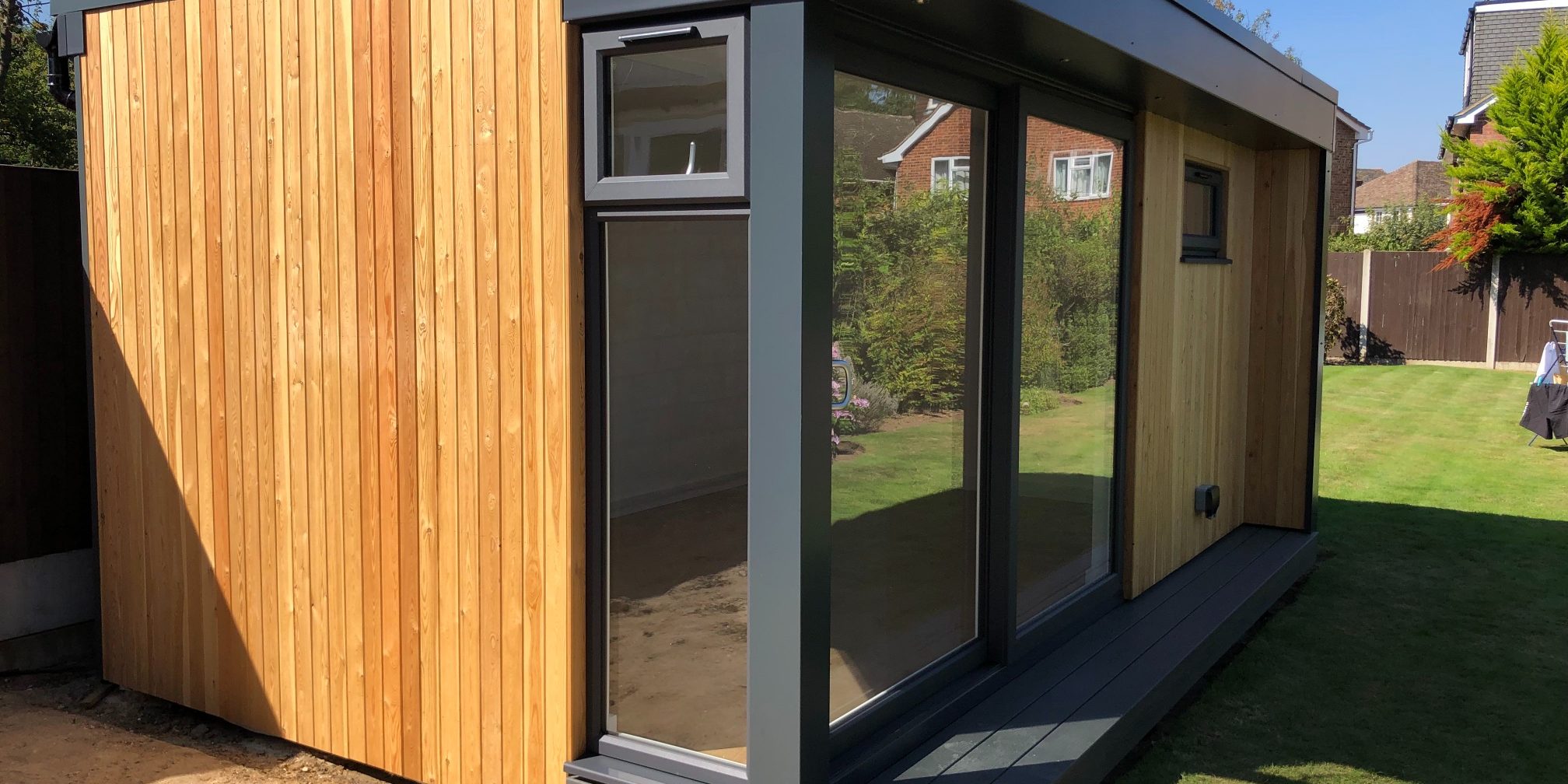
Yes, you can build a garden room in a conservation area. In most cases, a garden room placed in your rear garden will still fall under permitted development, even on conservation area land. But there are extra restrictions you need to know about, and in some cases you will need planning permission. Here is what actually applies and what does not.
What Changes When Your Property Is in a Conservation Area?
Conservation areas are classed as “designated land” under the Town and Country Planning (General Permitted Development) Order 2015. Garden rooms fall under Class E of this order, which covers buildings incidental to the enjoyment of a dwellinghouse. The standard permitted development rules still apply in conservation areas, but two additional restrictions are added on top.
No building to the side of your house
On designated land (which includes conservation areas), you cannot place any outbuilding on land between a wall forming a side elevation of your house and the boundary of your property. This means the strip of land running along the side of your home is off limits for a garden room without planning permission. In a normal (non-designated) area, you could place an outbuilding there provided it met the other size and height rules.
No building forward of the principal elevation
This rule applies everywhere, not just conservation areas, but it is worth repeating. You cannot place a garden room in front of the building line of your house. In practice, this means rear gardens only.
What About the 10 Square Metre Rule?
There is a common misconception that garden buildings in conservation areas are limited to 10 square metres if placed more than 20 metres from the house. This is not correct for conservation areas. The 10 square metre rule in Class E applies only to National Parks, the Broads, Areas of Outstanding Natural Beauty, and World Heritage Sites. Conservation areas are not included in that particular restriction.
So if your property is in a conservation area but not in one of those other designated areas, the 10 square metre cap does not apply to you. You can build a garden room in your rear garden up to the normal permitted development limits.
The Standard Rules That Still Apply
In a conservation area, your garden room still needs to meet all the normal Class E permitted development conditions. These are the same rules that apply to any property in England:
- Maximum height of 2.5 metres if the building is within 2 metres of any boundary
- Maximum eaves height of 2.5 metres in all cases
- Maximum overall height of 4 metres with a dual pitched roof, or 3 metres for any other roof type
- No more than 50% of the curtilage (the land around your original house) can be covered by outbuildings, extensions, and other additions combined
- The building must be single storey only
- The building must be used for purposes incidental to the house (a home office, gym, or hobby room qualifies, but a separate dwelling does not)
Our Midi, Maxi, and Multi garden rooms are all designed to sit within these limits. You can read more about the general rules on our planning permission and building regulations page.
Article 4 Directions: When Everything Changes
This is where things get more complicated. Your local council has the power to make what is called an Article 4 Direction, which removes some or all of your permitted development rights. These are most commonly applied within conservation areas, though they can be used anywhere.
If an Article 4 Direction is in force on your property and it covers Class E outbuildings, you will need to apply for planning permission for any garden room, regardless of its size or position. The direction might remove all permitted development rights or just specific ones, so you need to check the exact wording.
How to check for Article 4 Directions
Your council’s website will have a list of Article 4 Directions and the areas they cover. For example, Bromley has 47 conservation areas and several Article 4 Directions in places like Petts Wood and Chislehurst Road. Sevenoaks has 41 conservation areas across the district. Each one may or may not have additional Article 4 restrictions.
You can usually find this information by searching your council’s planning pages or their interactive planning maps. If you are not sure, a quick phone call to the planning department will confirm what applies to your address.
Listed Buildings Within Conservation Areas
Many properties in conservation areas are also listed buildings. If your house is a listed building, the rules are significantly stricter. Within the curtilage of a listed building, any outbuilding requires planning permission. Full stop. Permitted development rights for Class E outbuildings do not apply.
You will also need Listed Building Consent for any works that affect the character of the listed building or its setting. This is a separate application from planning permission and is assessed by the council’s conservation officer.
Even if your house is not itself listed, be aware that some structures within the grounds of a listed building can be “curtilage listed” by association. If the neighbouring property is listed and your land was historically part of its curtilage, you may be caught by these rules. It is unusual, but worth checking if you live next to a listed building in a conservation area.
Applying for Planning Permission in a Conservation Area
If you do need planning permission, whether because of an Article 4 Direction, a listed building, or because your preferred location is to the side of the house, the process is a standard householder planning application. Here are some practical tips to improve your chances of approval.
Read the Conservation Area Appraisal
Every conservation area should have a published appraisal document that explains what makes the area special and what the council is trying to protect. Read it before you submit anything. If your garden room design responds to the points raised in the appraisal, the planning officer will notice.
Keep it in the rear garden
A garden room positioned in the rear garden, well away from the street, is far less likely to face objections. Conservation area rules are primarily about protecting the character of the area as seen from public spaces. A building that is not visible from the road or any public footpath is much easier to justify.
Choose sympathetic materials and design
Conservation officers want to see that new buildings respect the character of the area. This does not mean your garden room has to look like a Victorian potting shed. A well designed, well proportioned modern building with quality materials can sit comfortably in a conservation area. What matters is that the design has been thought through, not just dropped in.
If you are considering a bespoke garden room, we can work with you on the external finish and proportions to make sure the design is appropriate for your setting.
Request a pre-application meeting
Most councils offer pre-application advice for a small fee. This gives you a chance to discuss your plans with the planning officer or conservation officer before you submit a formal application. It is well worth doing. You will get a clear steer on whether your proposal is likely to be approved and what changes might help.
Provide a Heritage Statement
For applications in conservation areas, you will typically need to include a Heritage Statement. This is a short document that explains the significance of the conservation area, how your proposal affects it, and why the impact is acceptable. It does not need to be long, but it does need to show that you have considered the heritage context.
Practical Steps Before You Start
Whether you think you need planning permission or not, we always recommend these steps for customers in conservation areas:
- Check your council’s interactive map to confirm your property is in a conservation area and whether any Article 4 Directions apply
- Read the Conservation Area Appraisal for your specific area
- Contact your council’s planning department if you are unsure about anything. A quick email or phone call can save months of delay
- Consider a lawful development certificate if you want written confirmation from the council that your garden room is permitted development. This is not compulsory but gives you peace of mind and can be useful if you sell the property later
- Talk to us about your plans. We have been building garden rooms across SE London, Kent, and Surrey since 2004 and have plenty of experience with conservation area projects
The Bottom Line
Living in a conservation area does not automatically mean you need planning permission for a garden room. The main restriction is that you cannot build to the side of your house, and you need to watch out for Article 4 Directions that might remove your permitted development rights entirely. If your property is also a listed building, you will need both planning permission and Listed Building Consent.
For the majority of conservation area properties, a garden room in the rear garden, built within the standard size and height limits, is perfectly achievable under permitted development. The key is checking your specific situation before you commit.
If you would like to discuss your project, get in touch with us. We will help you work out what applies to your property and what your options are.
Ambassador Programme
Already had a garden room built by us? Our Ambassador Programme gives you a saving of up to £5,000 when you refer someone who goes on to place an order. It is our way of saying thank you to customers who spread the word.