

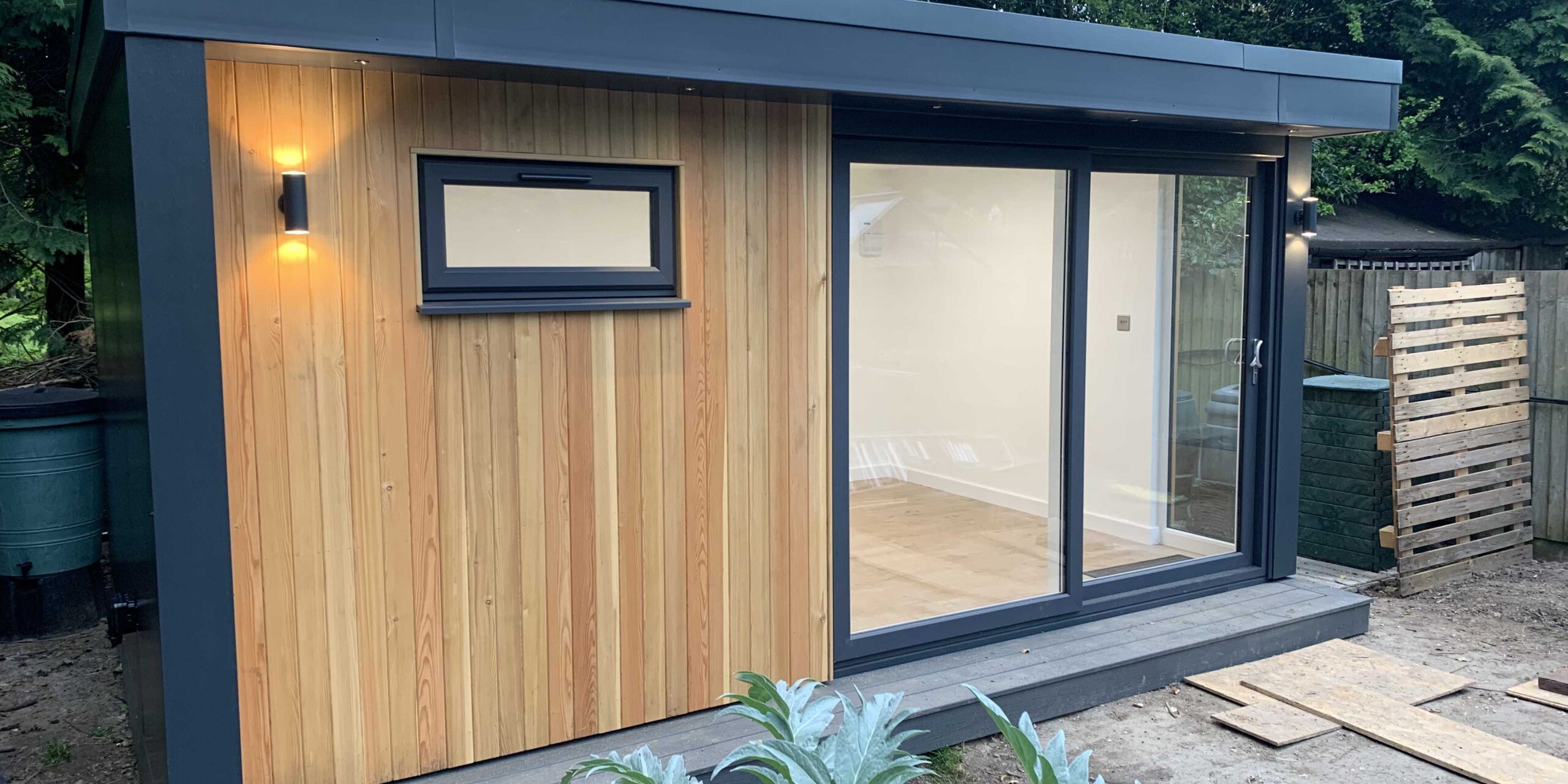
If you have been searching for an ex display garden room, you are probably hoping to get a quality building at a reduced price. It is a sensible instinct. Display models from reputable manufacturers are typically well built, often less than 12 months old, and come with discounts of 25 to 40 per cent off the original price. On paper, it looks like an obvious win.
But there are catches. Significant ones. As a family garden room company that has completed over 1,000 builds across South East London, Kent, Surrey, and Sussex since 2004, we have seen customers who went the ex display route and were happy with the result. We have also seen plenty who wished they had just ordered a new build to their own specification. Here is an honest breakdown of the pros, cons, and hidden costs so you can decide for yourself.
What Exactly Is an Ex Display Garden Room?
An ex display garden room is a model that has been sitting in a manufacturer’s or retailer’s showroom, usually outdoors, for anywhere from six months to a couple of years. Companies rotate their display stock to keep showrooms fresh, and they sell off the older models at a discount to make room.
This is different from a second hand garden room, which is a building that has been installed in someone’s garden and used as a home office, gym, or whatever else. Second hand units are typically sold privately (eBay, Facebook Marketplace, Gumtree) and come with their own set of risks, which we will cover below.
There is also a growing market for ex display composite garden rooms. Composite cladding is lower maintenance than timber, so these units tend to hold up better as display models. However, the same considerations around size, specification, and relocation costs still apply.
The Genuine Advantages of Buying Ex Display
1. Real Savings on the Purchase Price
The discounts are genuine. Based on what UK suppliers currently offer, you can expect to save between 25 and 40 per cent off the original price. Some end-of-season clearances push closer to 50 per cent. On a garden room that originally cost £20,000, that could mean paying £12,000 to £15,000 instead. That is a meaningful amount of money.
2. You Can See Exactly What You Are Getting
With a new build, you are working from specifications, images, and perhaps a visit to a showroom. With an ex display unit, you can walk inside the actual building you will own. You can check the finish, feel the space, open the doors and windows, and get a real sense of whether it works for you. There are no surprises about colour, texture, or build quality.
3. Faster Availability
New garden rooms typically involve a lead time of several weeks. An ex display model is already built and ready to go. Some suppliers advertise delivery within 14 working days. If you need a garden office quickly, this can be a real advantage.
4. Often Comes with Extras
Display models are frequently kitted out with optional extras that the manufacturer wanted to showcase: upgraded windows, premium cladding, additional sockets, better lighting. You may get features included in the price that you would pay extra for on a new build.
The Real Downsides (and Hidden Costs)
This is where things get more complicated. The purchase price is only part of the equation.
1. You Get What Is Available, Not What You Want
This is the biggest practical issue. An ex display garden room comes in one size, one layout, one specification. If you need a 4m x 3m room but the display model is 3m x 3m, you are stuck. If you wanted bi-fold doors on the long wall but the display has them on the short wall, that is what you get. If the internal layout does not suit your intended use, you cannot change it.
With a new build, you choose dimensions, door and window positions, internal layout, and specification to match your needs. With ex display, you are fitting your requirements around someone else’s design choices.
2. Relocation Costs Can Eat Into Your Savings
The display model is sitting in a showroom. It needs to get to your garden. This is not as simple as loading it onto a lorry.
Smaller garden rooms without plastered interiors can sometimes be dismantled, transported, and reassembled. Larger or more heavily finished buildings need to be craned onto a lorry and transported whole, which requires a hiab (lorry-mounted crane) or a separate mobile crane if the building is far from road access.
Realistic relocation costs start at around £1,500 for a small, straightforward job and can reach several thousand pounds for larger buildings, difficult access, or longer distances. You will also need a new base or foundation prepared at your end, which adds further cost. By the time you add relocation, a new base, any electrical reconnection, and making good after installation, that 30 per cent saving can shrink to 10 or 15 per cent.
3. Access Problems Can Kill the Deal
Getting a pre-built garden room into a back garden requires clear access. The crane or hiab needs to reach from the road into your garden with enough clearance. Trees, overhead cables, narrow side passages, and neighbouring properties all create obstacles. Some suppliers conduct a site survey before committing, but others sell “site unseen” and the access problem only becomes apparent on delivery day.
4. Wear, Weathering, and Cosmetic Damage
Display models sit outdoors for months or years. Expect some UV fading, minor scuffs from visitors, weathering on seals and gaskets, and cosmetic marks. An ex display composite garden room will generally fare better than timber, as composite cladding resists UV and moisture. But no building that has been sitting outside for a year will look factory fresh.
5. Warranty May Be Reduced or Different
Warranty terms vary significantly between suppliers. Some companies, like Nordic Garden Buildings and Frenchmoor, offer a full 5-year warranty on ex display units. Others offer reduced terms. A few sell on an “as seen” basis with minimal coverage. Always ask for the warranty terms in writing before you commit, and check what is actually covered. A “structural warranty” that excludes cladding, seals, windows, and hardware is not worth much in practice.
Compare this to a new build from a reputable manufacturer, which will typically come with a full 10-year warranty covering the structure and workmanship.
6. No Customisation After Purchase
Modifying an ex display unit after purchase is expensive and often impractical. Adding a window or moving a door on a finished building is far more disruptive than specifying it correctly from the start. If your garden has specific constraints, a pre-built display model is unlikely to address them.
What About Second Hand Garden Rooms?
Buying a second hand garden room from a private seller carries more risk than ex display. These buildings have been installed, used, and sold because the owner no longer wants them or is moving house.
The additional concerns include:
- Unknown maintenance history. You cannot verify how well the building has been maintained or whether minor issues have been left to worsen.
- Dismantling damage. Interlocking timber panels, insulation, and internal finishes all need to be carefully removed and numbered for reassembly. Damage during this process is common.
- No warranty. A private sale almost certainly comes with no warranty at all.
- Structural unknowns. Timber expands and contracts with the seasons, sometimes by 30 to 40mm across a building. A second hand room may have developed gaps, warping, or water ingress that is not immediately visible.
- Foundation mismatch. Your garden will need a new base, and the building dimensions need to match exactly.
For most second hand garden rooms, the total cost of purchase, dismantling, transport, a new base, reinstallation, and fixing any damage gets uncomfortably close to the cost of a new build, without the warranty or the ability to customise.
When Ex Display Makes Sense
To be fair, there are situations where buying ex display is a genuinely good decision:
- The display model happens to be the right size and layout for your needs
- Your garden has straightforward access for delivery
- The supplier offers a decent warranty (5 years minimum)
- The relocation and base costs have been quoted and factored into your budget
- You have physically inspected the building and are satisfied with its condition
- The total cost (purchase plus relocation plus base plus electrics) is still meaningfully less than a new build to spec
If all of those boxes are ticked, go for it. You will get a good building at a fair price.
When a New Build to Spec Is the Better Choice
For most people, though, ordering a new garden room built to your exact requirements works out better. You get the exact size for your garden, doors and windows positioned for your plot, a specification matched to your intended use, a full warranty from day one, no relocation cost, and no compromise on condition.
The price difference, once you add up all the hidden costs of ex display, is often surprisingly small. A 30 per cent saving on the sticker price can easily become a 10 per cent saving once relocation, a new base, electrical work, and cosmetic touch-ups are factored in. At that point, you are saving a modest amount but giving up the ability to get exactly what you want.
Browse our full range with prices to see what a new build actually costs. Many people are surprised to find the gap between ex display and new is smaller than they assumed. If you have something specific in mind, our bespoke garden rooms are designed and built around your exact requirements, from dimensions to finishes.
A Quick Checklist If You Do Buy Ex Display
If you decide to go ahead with an ex display or second hand garden room, protect yourself with these checks:
- Visit in person. Never buy a garden room without physically inspecting it. Check for damp, soft spots in timber, seal condition around windows and doors, and any signs of water ingress.
- Get the warranty in writing. Ask exactly what is covered, for how long, and whether it transfers to a new site.
- Get a full relocation quote. Include dismantling or craning, transport, a new base at your property, reinstallation, and electrical reconnection. Get this in writing before you commit to the purchase.
- Check access at your property. Measure the side access to your garden. If a crane is needed, check for overhead cables, trees, and clearance requirements. Ask the supplier to do a site survey.
- Understand what is included. Does the price include delivery and installation? Electrical reconnection? The base? Or just the building itself sitting in the showroom?
- Compare the total cost to a new build. Add up every cost associated with the ex display purchase and compare it honestly to a new garden room built to your specification. The answer may surprise you.
Our View
We do not sell ex display garden rooms ourselves. Every building we produce is made to order, so we are not impartial on this topic and want to be upfront about that.
But our reasoning is straightforward. Every garden is different. A garden room designed to look good in a showroom is not the same as one designed to fit perfectly into your specific garden, with the right doors in the right places, the right glazing for your aspect, and the right internal layout for how you will actually use the space.
If you would like to see what we build, you are welcome to visit our showroom to see the quality in person. Or get in touch and we will give you a straight answer on pricing for your project.
Save £5,000 with Our Ambassador Programme
If you like the idea of a new garden room built to your specification but want to keep costs down, our Ambassador Programme offers a £5,000 saving. In return, you allow us to photograph your completed build and host a small number of viewing visits for prospective customers. It is a straightforward arrangement that has helped hundreds of our customers get more garden room for their budget.