

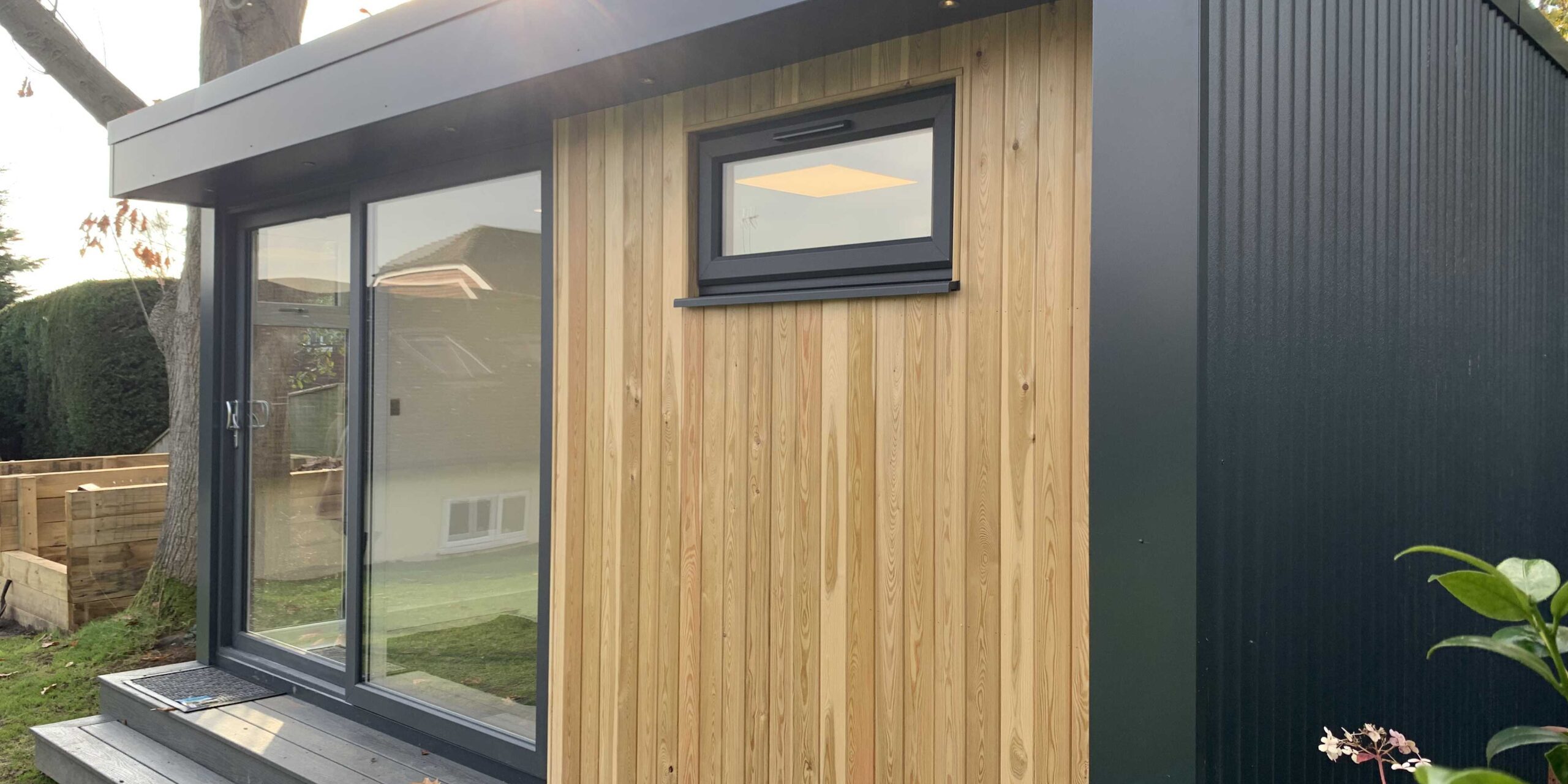
Getting the furniture right in your garden room makes all the difference between a space you actually use every day and one that sits there half empty. We have built over 1,000 garden rooms across South East London, Kent, Surrey, and Sussex since 2004, and we have seen every kind of setup. Home offices, therapy rooms, art studios, home gyms, guest bedrooms, and plenty of rooms that do two or three of those things at once. The furniture choices people make in the first few weeks after their build is finished shape how well the room works for years to come.
Here are our best garden room furniture ideas, based on what we have seen work well across hundreds of builds.
Start With Your Desk
If your garden room is a home office, the desk is the most important piece of furniture you will buy. It sets the tone for the whole space and determines how comfortable you are during working hours.
For most garden offices, a desk around 120cm to 140cm wide and 60cm to 70cm deep is the sweet spot. That gives you enough room for a monitor, keyboard, and some desk space for notes or a second screen, without dominating the room. Corner desks can work well in smaller rooms because they tuck into an unused area and give you a surprisingly large work surface.
Sit-stand desks have become very popular with our customers. Alternating between sitting and standing throughout the day is better for your back and your energy levels. The FlexiSpot E7 and IKEA BEKANT are both solid options in the UK, with prices typically between £300 and £600 for an electric model.
One thing to think about is desk placement relative to your windows. You want natural light, but you do not want glare on your screen. Placing your desk perpendicular to the window, so light comes in from the side, is usually the best solution. Facing the window can cause eye strain, and having the window behind you creates glare on video calls.
Invest in a Proper Chair
This is the one item where we always tell customers not to cut corners. If you are sitting for six to eight hours a day, your chair matters more than anything else in the room. A bad chair will leave you with back pain, neck stiffness, and the temptation to go back to working at the kitchen table.
Look for a chair with adjustable seat height, adjustable lumbar support, and armrests that can be moved up, down, forward, and back. Your feet should sit flat on the floor with your hips slightly higher than your knees. The backrest should support the natural curve of your lower spine.
At the higher end, the Herman Miller Aeron and Steelcase Leap are the chairs ergonomists recommend most often. They cost upwards of £1,000, but they last 10 to 15 years. If that is more than you want to spend, UK suppliers like Posturite stock good ergonomic chairs in the £300 to £500 range. Whatever you choose, sit in it before you buy if you can. Ergonomics is personal, and what suits one person can be uncomfortable for another.
Storage That Works in a Smaller Space
Garden rooms are not huge. Even our larger Maxi buildings need thoughtful storage planning, and our more compact models need it even more. The key is to use vertical space and choose furniture that does double duty.
Wall Mounted Shelving
The simplest and most effective storage solution for any garden room. A single row of shelves running along the top of one wall, just below the ceiling, gives you a surprising amount of storage without taking up any floor space at all. Use it for books, files, storage boxes, or decorative items. Modular shelving systems are especially useful because you can add sections as your needs grow.
Pegboards
Pegboards have made a real comeback in home office and studio design. They are cheap, easy to fit, and incredibly versatile. You can hang organisers, shelves, hooks, and holders in whatever arrangement suits your workflow, then rearrange them whenever you like. They work brilliantly in craft studios, workshops, and home offices alike.
Storage Benches and Ottomans
If your garden room has a seating area, choose seats that open up to reveal storage inside. A storage bench along one wall gives you somewhere to sit during breaks and somewhere to stash blankets, files, or equipment out of sight. Storage ottomans do the same job in a smaller footprint.
Under Desk Storage
A compact filing cabinet or set of drawers on castors that fits under your desk keeps paperwork and supplies within reach without taking up additional floor area. When you need more floor space, just roll it out of the way.
Furniture for Multi-Use Garden Rooms
Many of our customers use their garden room for more than one purpose. An office during the week might become a yoga space at the weekend, or a therapy room that doubles as a guest bedroom when family visits. If your room needs to serve multiple roles, the furniture you choose becomes even more important.
Sofa Beds and Day Beds
A good sofa bed is probably the single most useful piece of furniture in a multi-use garden room. During the day, it gives you a comfortable seat for reading or meeting clients. At night, it folds out into a proper bed for guests. Look for one with a decent mattress rather than a thin pad.
Day beds are another strong option. Pile one with cushions during the day and it looks like a sofa. Pull the cushions off in the evening and it is ready for sleeping. They take up less depth than a sofa bed, which matters in compact rooms.
Folding and Collapsible Furniture
Wall-mounted fold-down desks are brilliant for rooms that need to switch between uses. When the desk is folded up against the wall, the room is free for exercise, music practice, or whatever else you need the floor space for. Folding chairs that hang on wall hooks work on the same principle. The room adapts to you rather than the other way around.
Zoning With Furniture
In larger garden rooms, like our Multi buildings, you can use furniture to create distinct zones without putting up walls. A bookshelf at right angles to the wall acts as a room divider while providing storage on both sides. A rug under the desk area visually separates the work zone from a relaxation area.
Garden Room Decor Ideas That Make a Difference
Furniture is the foundation, but decor is what makes a garden room feel like yours. Here are the finishing touches that we see making the biggest difference in our customers’ rooms.
Rugs
A good rug brings warmth, colour, and a sense of purpose to a garden room floor. It also helps with acoustics, which matters more than you might think in a timber-framed building. In a home office, a rug under your desk and chair defines the workspace. Natural materials like wool and jute look great, but synthetic options like polypropylene are more hard-wearing and easier to clean.
Plants
A few potted plants on a windowsill or shelf connect your garden room visually with the garden outside. Research shows that plants in a workspace reduce stress and improve concentration. Low-maintenance options like snake plants, pothos, and succulents are ideal if you are not a confident gardener.
Lighting
Your garden room will have plenty of natural light during the day, but you need to plan for darker months and evening use. A layered approach works best: overhead LEDs for general brightness, a desk lamp for focused task lighting, and a softer table lamp or floor lamp for relaxing. For task lighting, bulbs around 4000K to 5000K (cool white) keep you alert. For evenings, warmer tones around 2700K to 3000K create a cosier atmosphere.
Soft Furnishings and Personal Touches
Cushions and throws on a sofa or chair make a garden room feel lived in rather than clinical. They also give you an easy way to change the look with the seasons. Add framed prints, photographs, or a pinboard of ideas to make the space feel like yours. The Scandinavian approach of keeping things simple, with just a few well-chosen pieces rather than covering every surface, tends to work well in a compact room.
Furniture Mistakes to Avoid
After seeing so many garden rooms finished and furnished, we have a good sense of what does not work as well as people hope.
- Buying furniture that is too big. Measure your room carefully and measure the furniture before you order it. A three-seater sofa that looked fine in the showroom can overwhelm a garden room and leave you with no space to move around. When in doubt, go smaller.
- Forgetting about cable management. Choose a desk with built-in cable routing or add a cable tray underneath. It is a small detail that makes a big difference to how the room feels.
- Ignoring temperature. Leather can feel cold on winter mornings before the heating kicks in. Metal desks can feel chilly to the touch. Fabric upholstery and timber desks tend to feel more comfortable in a garden building.
- Skipping the break area. Even a small armchair in the corner with a side table gives you a place to have a cup of tea or just think. Without one, you end up going back to the house every time you need a pause, and that breaks your flow.
Furnishing Different Sizes of Garden Room
The amount of furniture you can comfortably fit depends on the size of your building. Here is a rough guide based on the sizes we build most often.
Compact Rooms (up to 10 square metres)
Keep it simple. A desk, an ergonomic chair, a wall shelf, and perhaps a small side table is plenty. Every piece needs to earn its place. Wall-mounted and fold-down furniture is your friend here. A compact Midi garden room can be a very effective home office with just four or five carefully chosen pieces.
Medium Rooms (10 to 15 square metres)
You have room for a proper desk setup, a bookcase or storage unit, and a small seating area. This is where a two-seater sofa or a day bed starts to make sense. You can create a clear work zone and a break zone without the room feeling cramped.
Larger Rooms (15 square metres and above)
With more space, you can think about distinct zones. A full desk and chair setup, a sofa or sofa bed, a coffee table, bookshelves, and perhaps a side desk or reading nook. Larger rooms also work well as combined office and gym spaces, where one end has a desk and the other has exercise equipment with a rubber mat.
Where to Buy Garden Room Furniture in the UK
You do not need to spend a fortune. IKEA is a solid starting point for desks, shelving, and storage, particularly the KALLAX and BILLY ranges. John Lewis and Made.com carry mid-range furniture that looks good and lasts well. Second-hand office furniture dealers are also worth a look. A solid timber desk from a dealer costs a fraction of the new price and is often better made than budget new options.
Getting Started
The best advice we can give is to live in your garden room for a week or two before buying everything. Use a temporary setup at first and see how you actually use the space. You will quickly discover where the desk should go, where the light falls, and how much storage you really need.
If you are at the planning stage, have a look at our buildings and prices to see the sizes available, or get in touch and we will be happy to help.
Save £5,000 with Our Ambassador Programme
If you are planning a garden room build, ask us about our Ambassador Programme. Ambassadors let us use their finished garden room for a small number of photography and viewing visits. In return, you save £5,000 off the price. It is a simple arrangement that benefits both sides.