

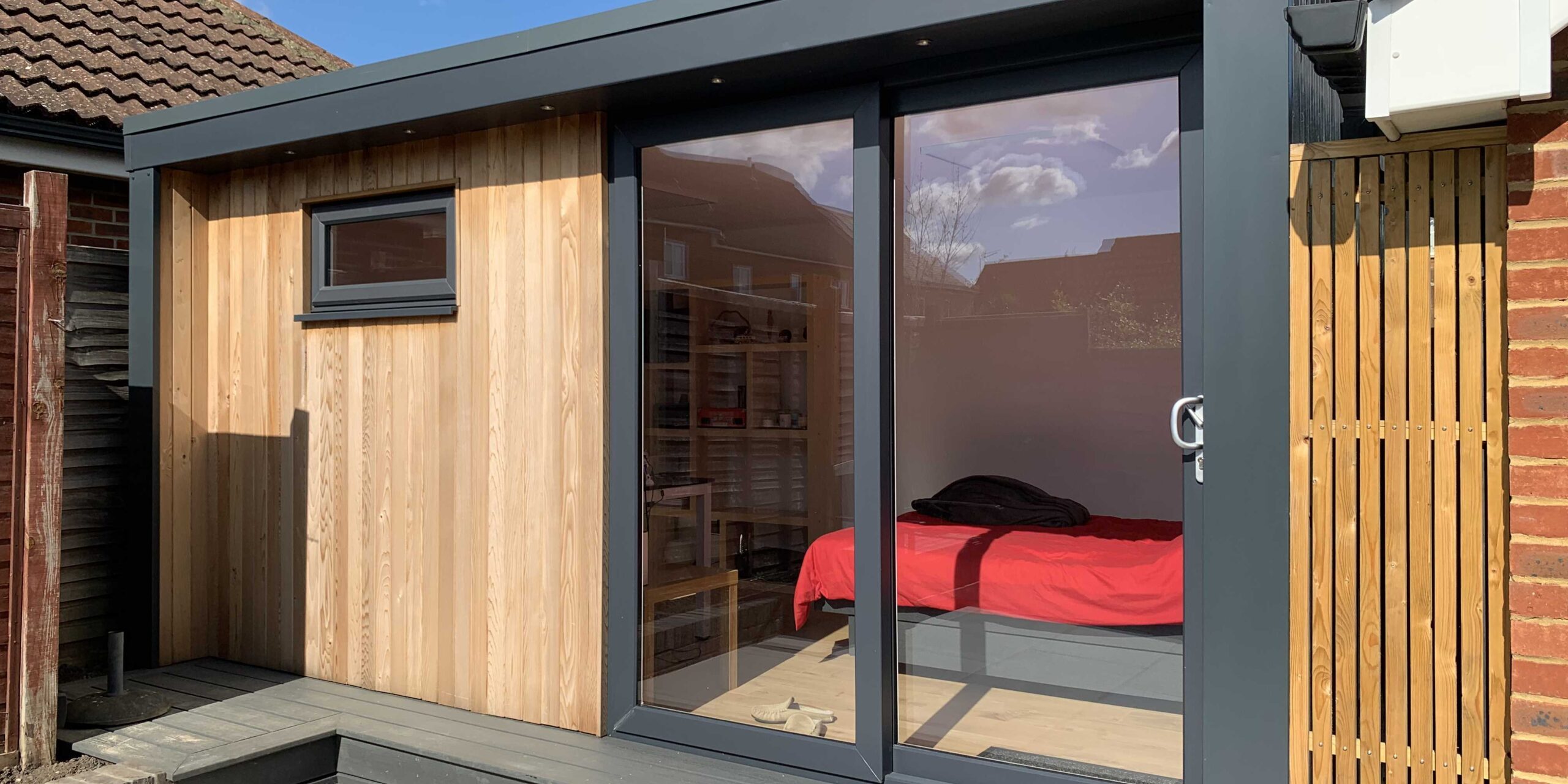
A single room garden office is a brilliant thing. But there comes a point where one open space is not quite enough. Maybe you need somewhere to take client calls without your desk clutter on display. Maybe your partner works from home too, and you are both tired of headphones and polite silence. Or perhaps you want a proper home gym alongside your workspace, without dumbbells rolling under your monitor stand.
That is where a two room garden office comes in. By splitting a larger garden building into two distinct zones, you get the flexibility to combine work with almost anything else, all within a single structure at the end of your garden. We have been building garden rooms across South East London, Kent, Surrey, and Sussex since 2004, and multi-room layouts are now one of our most popular requests. Here is what we have learned about making them work.
Why Choose a Garden Office with Two Rooms?
A two room layout lets you do two things properly, rather than one thing with compromises. In a single open room, you are always making trade-offs. Your meeting backdrop is the tumble dryer you stashed in the corner. Your storage boxes creep closer to your workspace month by month.
With a partition wall and a door between two spaces, each room does its job without interfering with the other. The most popular combinations we see are:
- Office plus meeting room. Your main workspace stays set up exactly how you like it, while a second, tidier room handles video calls, client visits, and team meetings. This is especially popular with consultants, accountants, and anyone who occasionally has people visiting.
- Office plus home gym. You work on one side and train on the other. No more dragging equipment out and putting it away. The gym is always ready, and your office stays clear of anything that smells of rubber matting.
- Office plus therapy or treatment room. If you run a business from your garden room, a waiting area or treatment space alongside your admin room makes the whole setup feel professional.
- Office plus storage and utility. Sometimes the second room is simply practical. Filing cabinets, a printer, a small kitchenette, or storage that would otherwise clutter your workspace.
- Two separate offices. Ideal for couples who both work from home. Separate rooms mean separate phone calls, separate music, and separate mess.
How Big Does It Need to Be?
This is the first question to get right. A two room garden office needs enough floor area for both spaces to feel comfortable, plus the wall thickness of the partition itself.
As a rough guide, you want a minimum of around 18 to 20 square metres of internal floor space for a practical two room layout. Anything smaller and you risk ending up with two rooms that both feel cramped, which defeats the point.
Our Multi measures 6.0m by 4.0m externally, giving roughly 24 square metres of space. That is enough for a comfortable main office of around 14 square metres and a second room of around 9 square metres, accounting for the internal partition wall. For most combinations, that works well.
If you need both rooms to be genuinely generous, our Multi+ at 7.0m by 4.5m gives you roughly 31.5 square metres to work with. That allows for two rooms of around 15 to 16 square metres each, or a larger primary room with a smaller but still very usable second space. The extra depth means neither room feels like a corridor.
For anything unusual, such as an L-shaped layout, three rooms, or a room with an en-suite shower, a bespoke design lets us work to your exact requirements.
Getting the Split Right
Where you place the partition matters. A few things to think about:
- Which room needs more space? If one room is your primary workspace and the other is a small meeting area or storage room, an uneven split makes sense. A 60/40 or even 70/30 division works well when the rooms serve different purposes.
- Where are the doors and windows? The partition needs to work with the existing door and window positions. Ideally, both rooms should have at least one window for natural light and ventilation. We plan this from the start so neither room ends up feeling dark.
- Do you need separate external access? Some layouts benefit from each room having its own outside door. This is especially useful if one room is a storage area you want to access without walking through your office, or if clients visit the meeting room directly.
Partition Options: What Goes Between the Two Rooms?
The type of partition you choose affects how the two rooms feel, how much sound travels between them, and how flexible the layout is over time.
Full Stud Wall with Door
This is the most common choice. A timber stud wall, plastered and painted to match the rest of the interior, with a standard internal door. It gives you complete visual and acoustic separation between the two rooms. If soundproofing matters, we can fill the stud cavity with acoustic mineral wool, typically at a density of 60kg per cubic metre or higher, which makes a significant difference to noise transfer. This is worth considering if you plan to take calls in one room while someone works or exercises in the other.
A solid stud wall is also the best option when one room serves a very different purpose from the other, such as a gym or storage space where you want a clean visual break.
Glazed Partition Wall
A partition with full height glazing, or a half-height wall with glass above, keeps both rooms feeling open and allows natural light to flow through the entire building. This works well when both rooms are workspaces, and it looks smart for anyone receiving clients.
The trade-off is less acoustic privacy. Glazed partitions reduce noise compared to a fully open room, but they will not block sound the way a properly insulated stud wall does.
Sliding or Pocket Door
A sliding door, or a pocket door that tucks into the wall when open, gives you the best of both worlds. Close it and you have two separate rooms. Open it and the space flows as one. This is ideal if you want flexibility, say an office plus meeting room during the week that becomes one large entertaining space at the weekend. Pocket doors are especially practical because they disappear completely into the wall structure, freeing up floor space on both sides.
Partial Wall or Room Divider
For a softer separation, a partial wall or freestanding room divider creates visual zones without fully enclosing either room. This suits layouts where both spaces serve similar purposes and you want to maintain an open feel. It does very little for noise, so it is best when both activities are quiet.
Soundproofing Between Rooms
If you are dividing your garden office into two rooms, sound transfer between them is worth thinking about carefully. A standard stud wall with plasterboard on each side will reduce noise, but it will not block it completely. For a noticeable improvement, you want:
- Acoustic mineral wool in the cavity. Rockwool or similar, at 60kg per cubic metre density or above, fitted snugly inside the stud frame. Leave a small air gap either side of the insulation rather than compressing it between the boards.
- A solid core door. A hollow internal door lets a surprising amount of sound through. A solid core door is heavier and denser, making a real difference. Draught strips around the frame help seal the gaps.
- Decoupled wall construction. For the best acoustic performance, the two layers of plasterboard can be mounted on resilient bars that reduce vibration transfer. This takes up slightly more width but is very effective.
We can advise on the right level of acoustic treatment based on what each room will be used for. A home gym next to a video call room needs more work than two quiet office spaces.
Practical Considerations
Electrics and Heating
Each room needs its own lighting, power sockets, and ideally its own heating control. There is no point having two rooms if you cannot turn the heating off in the gym while keeping the office warm, or if the meeting room has no sockets for a screen or laptop. We plan the electrical layout during the design stage so everything is where it needs to be.
Internet and Ventilation
Both rooms need reliable internet. If you are running ethernet from the house (which we always recommend), run cables to both rooms during the build. Retrofitting network cable through a finished partition wall is a nuisance. For ventilation, each room should have at least one openable window or trickle vent. If one room is a gym, mechanical extraction may be worth fitting.
Planning Permission
A two room garden office typically falls under permitted development, just the same as a single room building. It must be single storey, must not exceed 2.5m in height if within 2m of a boundary, and must not cover more than 50 per cent of the garden. Having two rooms inside does not change these rules. If your project sits within permitted development limits, no planning application is needed.
Which of Our Buildings Works Best?
For a two room layout, you need a building with enough floor area to divide comfortably. Two of our standard models are well suited:
- Multi (6.0m x 4.0m) at around 24 square metres. This gives you a strong main room and a useful second room. Both will have proper windows, and the overall proportions work well for an office plus meeting room, office plus gym, or office plus storage. Prices start from £35,455 including VAT, installation, and ground screw foundations.
- Multi+ (7.0m x 4.5m) at around 31.5 square metres. The bigger footprint means both rooms can be genuinely spacious. If you want two full-size offices, or a large gym alongside a comfortable workspace, the Multi+ gives you the room to do it properly.
Both buildings come with 100mm PIR insulation in the walls, floor, and roof, plastered and painted interiors, laminate flooring, LED downlights, and a full electrical package. Internal partition walls with doors are available as part of the specification.
For anything beyond a straightforward two room split, our bespoke service covers L-shaped designs, buildings with three or more rooms, en-suite facilities, and any other layout you have in mind.
Making the Most of Two Rooms
A few tips from twenty plus years of building these:
- Think about the view. Position the room you spend the most time in to face the nicest part of your garden. The storage room does not need the best window.
- Measure your furniture first. If you already own a particular desk or piece of gym equipment, make sure it fits comfortably in the room it is destined for. We have seen customers design around a standing desk only to realise it blocks the door swing.
- Do not split too small. Two decent rooms are better than two tiny ones. If your garden can only fit a smaller building, one well-planned open space may serve you better than two rooms that feel like cupboards.
- Light both rooms generously. A room behind a partition can feel darker than expected. Roof windows, extra LED downlights, or a glazed partition all help.
Get Started
If you are thinking about a garden office with two rooms, the first step is working out what each room needs to do and how much space that requires. We are happy to talk through the options, suggest a layout, and give you a clear price. You can browse our full range with prices or get in touch directly.
Save £5,000 with Our Ambassador Programme
Our Ambassador Programme offers a £5,000 saving on your build. In return, you allow us to photograph your completed garden room and host a small number of viewing visits for prospective customers. It is a straightforward arrangement that has helped hundreds of our customers get more from their budget. If you are interested, mention it when you get in touch.