

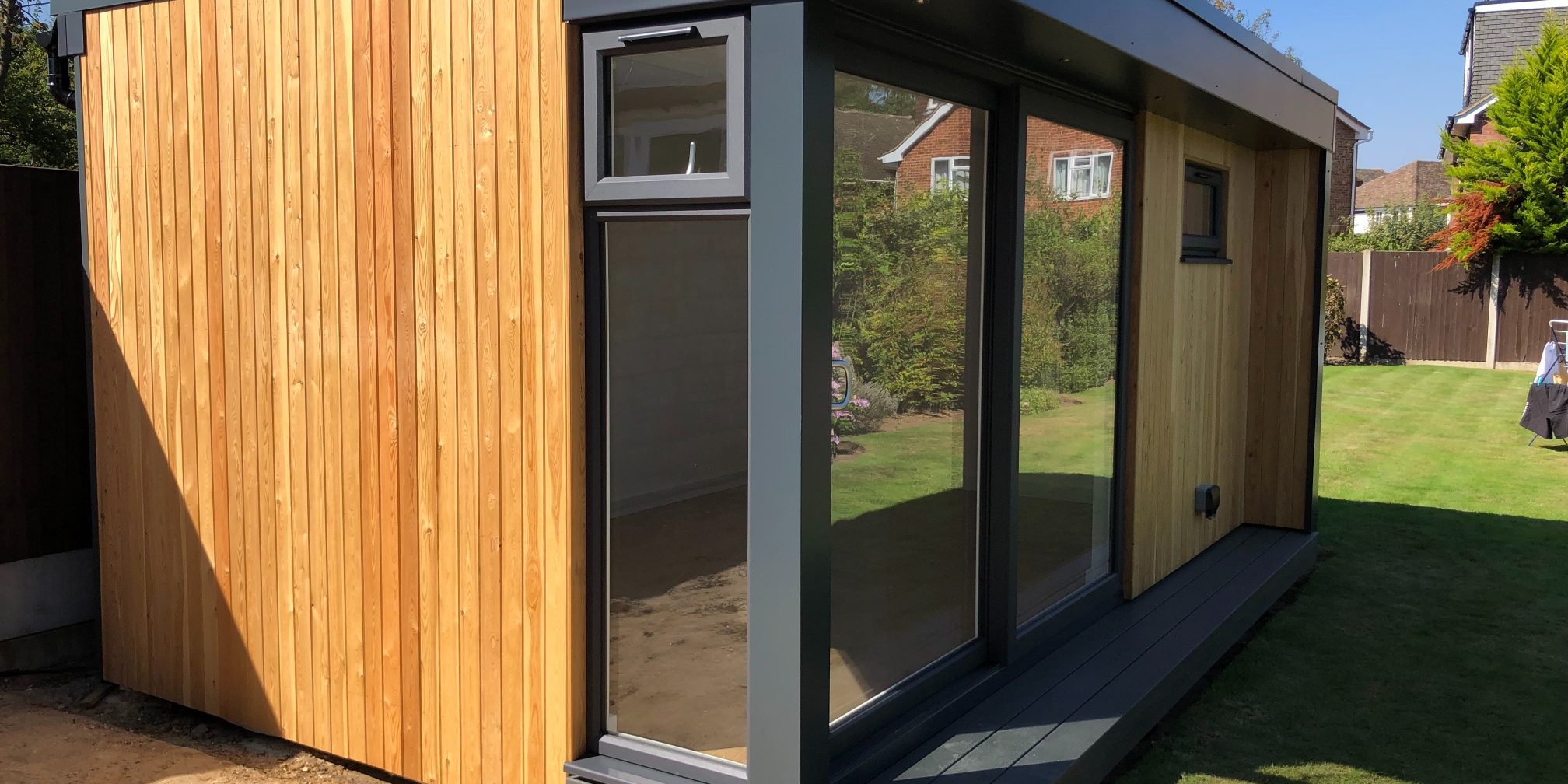
Can you claim a garden office on tax? The short answer is: partly. The building itself is not tax deductible, but the fixtures, fittings, and running costs often are. How much you can claim depends on whether you are self-employed, run a limited company, or work as an employee.
We have built over 1,000 garden rooms across South East London, Kent, Surrey, and Sussex since 2004. Tax questions come up in almost every conversation with customers who plan to use their garden room as an office. This guide covers what HMRC actually allows, what it does not, and the key things to discuss with your accountant before you buy.
Please note: tax rules change regularly, and this article reflects the position as of the 2025/26 tax year. We are garden room builders, not tax advisers. Always get professional advice tailored to your circumstances before making financial decisions based on tax treatment.
The Building Itself Is Not Tax Deductible
This is the part most people find disappointing. HMRC treats a garden office as a structure, and structures on residential land do not qualify for tax relief. The cost of the building, its delivery, installation, foundations, and any initial decoration like plastering or painting cannot be deducted from your taxable income or profits.
You might have heard of the Structures and Buildings Allowance (SBA), which gives tax relief on commercial buildings at 3% per year. Unfortunately, it specifically excludes structures on residential property. The legislation states that any building or structure on land intended to be enjoyed as part of the grounds of a residential property is treated as being in residential use. A garden office in your back garden falls squarely into that exclusion.
So the actual garden room itself? Not deductible. But that is not the full picture.
What You Can Claim: Fixtures, Fittings, and Integral Features
While the structure gets no relief, many of the components inside and attached to your garden office do qualify for capital allowances. These are classified as plant and machinery, and HMRC allows you to deduct their cost from your taxable profits.
Qualifying items typically include:
- Electrical wiring and lighting installations
- Heating systems
- Air conditioning
- Plumbing
- Thermal insulation (even though it is part of the structure, HMRC treats it as a qualifying fixture)
- Office furniture: desks, chairs, shelving
- IT equipment: computers, monitors, printers
- Fitted storage units
The Annual Investment Allowance (AIA) lets you claim 100% tax relief on qualifying plant and machinery spending up to £1 million per year. For most people buying a garden office, the eligible fixtures and fittings will be well within that limit. If your qualifying items total £5,000, you can deduct the full £5,000 from your taxable profit in the year you spend it.
One important practical point: ask your garden office supplier for an itemised invoice that separates the structural costs from the fixtures, fittings, and integral features. A single lump sum invoice makes it very difficult to support a capital allowances claim if HMRC asks questions. When we provide quotes and invoices, we can break down the components to help with exactly this.
Self-Employed and Sole Traders
If you are self-employed, the rules are relatively straightforward. Any business expense that is “wholly and exclusively” for the purpose of your trade can be deducted from your taxable profit on your Self Assessment return.
For the garden office itself, this means you can claim capital allowances on qualifying fixtures and fittings as described above. You cannot deduct the cost of the structure.
Running Costs
Ongoing expenses for your garden office are where the real day-to-day tax savings sit. If the office is used exclusively for business, you can claim:
- Electricity for lighting, heating, and running equipment
- Internet and phone costs (the business proportion)
- Repairs and maintenance
- Insurance for the building and its contents
- Cleaning costs
If your garden office has its own electricity meter or is billed separately from your house, you can treat those costs as a direct business expense. If the garden office shares your household utilities, you will need to work out a reasonable business proportion. HMRC accepts methods such as dividing by the number of rooms in the property (counting the garden office as one room) or calculating based on floor area and hours of use.
Simplified Expenses: The Flat Rate Option
Self-employed people can choose to use HMRC’s simplified expenses instead of calculating actual costs. The flat rates for working from home are:
- 25 to 50 hours per month: £10 per month
- 51 to 100 hours per month: £18 per month
- 101 or more hours per month: £26 per month
At the top rate, that works out to £312 per year. It is simple and requires minimal record-keeping, but for a garden office with dedicated electricity, heating, and broadband costs, the actual expenses method will almost certainly give you a larger deduction. The flat rate also does not include phone or internet expenses, which you can claim separately on top.
Use HMRC’s simplified expenses checker to compare both methods and see which gives you a better result.
Limited Company Directors
If you run a limited company, the tax treatment of a garden office is more complex and there are a few different approaches.
Option 1: The Company Buys the Garden Office
Your limited company can purchase the garden office. Capital allowances apply to qualifying fixtures and fittings in the same way as for sole traders, reducing your corporation tax bill.
The catch is benefit in kind. If HMRC considers that the garden office is available for your personal use (weekends, evenings, family members using it), a benefit in kind charge applies. This is calculated at 20% of the asset’s market value when first provided, plus any related costs the company pays. For a £30,000 garden office, that is a £6,000 annual benefit in kind. As a higher rate taxpayer, you would owe £2,400 in personal tax, and the company would pay Class 1A National Insurance at 15% on the benefit amount.
Proving exclusive business use to HMRC can be difficult, particularly for a building sitting in your personal garden.
Option 2: Rent the Space to Your Company
An alternative is to buy the garden office personally and then charge your company a market rate rent for using it. The company gets a tax deduction for the rent payment, and you declare the rental income on your personal tax return. You can offset costs against that rental income, including a proportion of utilities and maintenance.
This approach avoids the benefit in kind issue but needs a formal rental agreement at a genuine market rate. Your accountant can advise on what constitutes a reasonable figure.
VAT Considerations
If your business is VAT registered, you may be able to reclaim VAT on the purchase of the garden office and its contents. However, VAT recovery must be proportional to business use. If there is any personal use, you cannot claim the full amount. Businesses on the flat rate VAT scheme face additional restrictions and can only reclaim VAT on individual capital purchases over £2,000.
Employees Working from Home
If you are employed (not self-employed), the position is more restrictive.
For the 2025/26 tax year, employees who are required by their employer to work from home can claim a flat rate of £6 per week (£312 per year) for additional household costs, either through their employer tax-free or directly from HMRC. The key word is “required.” If you choose to work from home for convenience, you cannot claim.
There is an important change coming: from 6 April 2026, the ability to claim this allowance directly from HMRC is being abolished. After that date, employees will need their employer to reimburse homeworking costs directly. Employers can still pay up to £6 per week tax-free, but you will no longer be able to claim the tax relief yourself if your employer does not offer it.
As for the garden office building itself, employees generally cannot claim tax relief on its purchase. The cost is considered a personal expense. You cannot offset the price of a garden office against your employment income, even if you use it entirely for work.
The Capital Gains Tax Warning
This is something your accountant should flag, but it catches some people off guard. If you claim that part of your property is used exclusively for business, you may lose a portion of your Private Residence Relief (PRR) when you sell your home.
Normally, your main home is completely exempt from Capital Gains Tax when you sell it. But if a distinct area, such as a garden office, is used exclusively for business purposes, HMRC can argue that portion of the property does not qualify for PRR. If the garden office represents 5% of the total property by floor area, up to 5% of your capital gain on sale could be subject to CGT.
There are a few things that soften this:
- The annual CGT exemption (currently £3,000 for 2025/26) may cover a small gain
- If the garden office is a removable, non-permanent structure, HMRC may take a different view
- If you do not claim the space is used exclusively for business (i.e., it has some personal use too), PRR is typically not affected
This is one of the main reasons to get proper tax advice before you start claiming. The tax relief you gain on running costs might be outweighed by the CGT you pay when you eventually move house, depending on property values and how long you stay.
Business Rates
Another thing worth knowing: if you register your garden office as business premises, your local council may apply business rates. The good news is that properties with a rateable value of £12,000 or less pay nothing under small business rates relief. Most garden offices fall well within that threshold. Between £12,001 and £15,000, you get a graduated reduction.
However, registering for business rates means your property is formally part-commercial, which can affect your council tax band and could concern mortgage lenders or future buyers. Again, talk to your accountant before taking this step.
A Practical Summary
Here is a clear breakdown of what is and is not claimable:
Not Tax Deductible
- The garden office structure (walls, roof, floor, foundations)
- Delivery and installation of the building
- Initial decoration (plastering, painting)
Tax Deductible (via Capital Allowances)
- Electrical wiring and lighting
- Heating and air conditioning systems
- Plumbing
- Thermal insulation
- Office furniture and equipment
Tax Deductible (as Running Costs)
- Electricity and heating
- Business proportion of internet and phone
- Repairs and maintenance
- Insurance
Getting the Most from Your Garden Office Investment
The tax position on garden offices is not as generous as many people hope, but there are real savings available if you approach it correctly. The fixtures and fittings allowance, combined with ongoing running cost deductions, can add up to meaningful tax relief over the years.
Our advice from two decades of building garden offices: speak to your accountant before you buy, not after. Get your invoicing structured correctly from the start, keep records of business use, and make informed decisions about exclusive versus mixed use based on the CGT implications.
If you are ready to explore your options, take a look at our full range of garden offices with prices. We build every room ourselves using our own team, with 100mm PIR insulation as standard and a 10 year warranty. For something tailored to your exact needs, see our bespoke garden rooms page.
Got questions about specifications, invoicing for tax purposes, or anything else? Visit our FAQ page or get in touch directly.
Save £5,000 with Our Ambassador Programme
Want a quality garden office for less? Our Ambassador Programme offers a £5,000 saving on your build. In return, you allow us to photograph the completed garden room and host a small number of viewing visits for prospective customers. It is a straightforward arrangement that has helped hundreds of customers get more for their budget.