

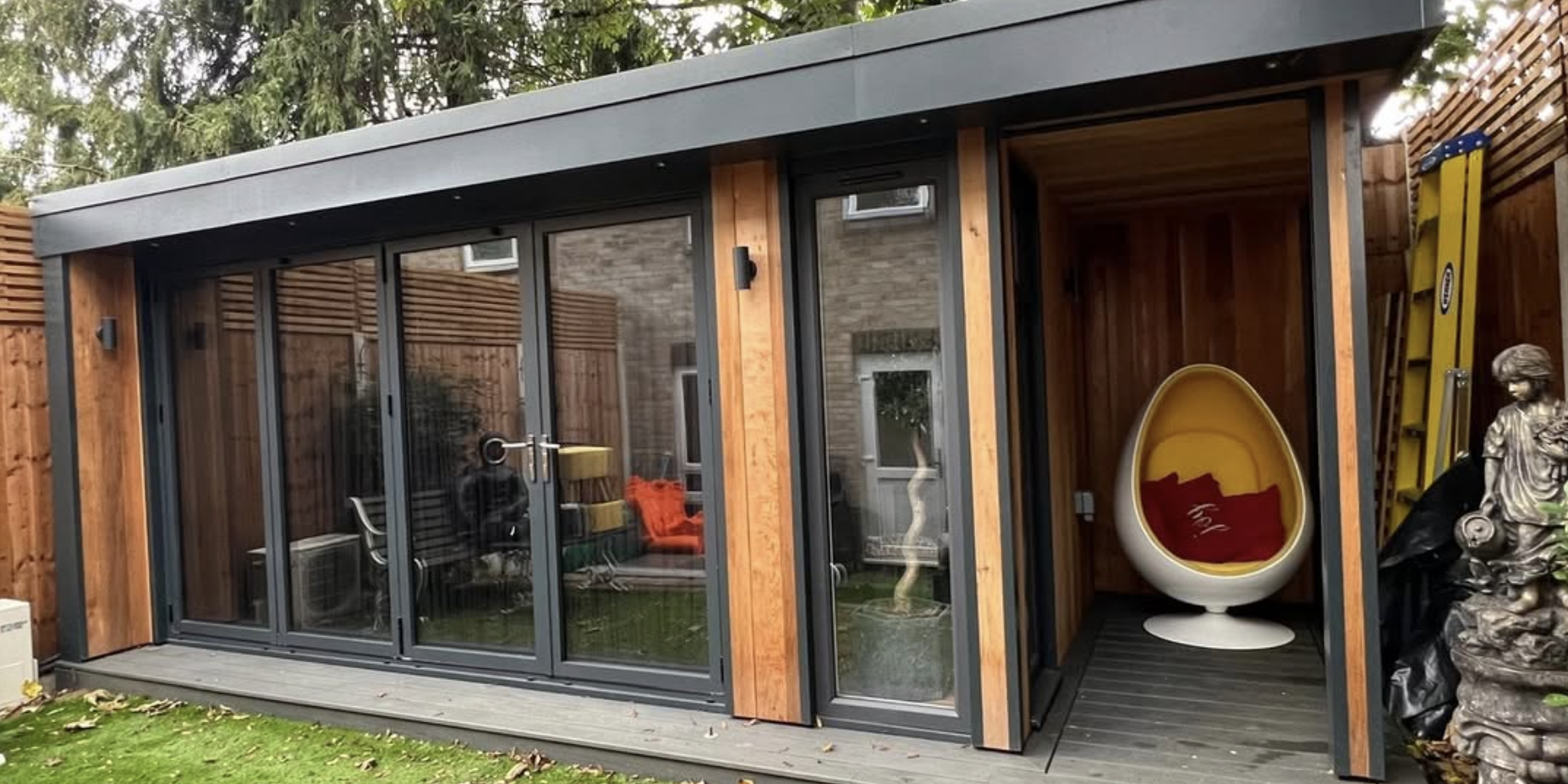
Most garden rooms in the UK do not need planning permission. Under permitted development rights, you can build a garden room in your back garden without applying to your local council, as long as you follow a clear set of rules on size, height, position, and use. These rules come from the Town and Country Planning (General Permitted Development) (England) Order 2015, Schedule 2, Part 1, Class E, which covers buildings incidental to the enjoyment of a dwellinghouse.
We have been building garden rooms across South East London, Kent, Surrey, and Sussex since 2004, and the question we hear most often is: “Do I need planning permission?” In the vast majority of cases the answer is no. But the rules are specific, and getting one wrong could mean an enforcement notice. Here is exactly what you need to know.
What Is Permitted Development?
Permitted development is a set of rights granted by Parliament that allows homeowners to carry out certain building works without submitting a planning application. Think of it as automatic planning permission, provided you stay within the limits.
For garden rooms, the relevant class is Class E of the General Permitted Development Order (GPDO). This covers “any building or enclosure required for a purpose incidental to the enjoyment of the dwellinghouse.” A home office, garden studio, gym, playroom, or hobby room all count as incidental uses.
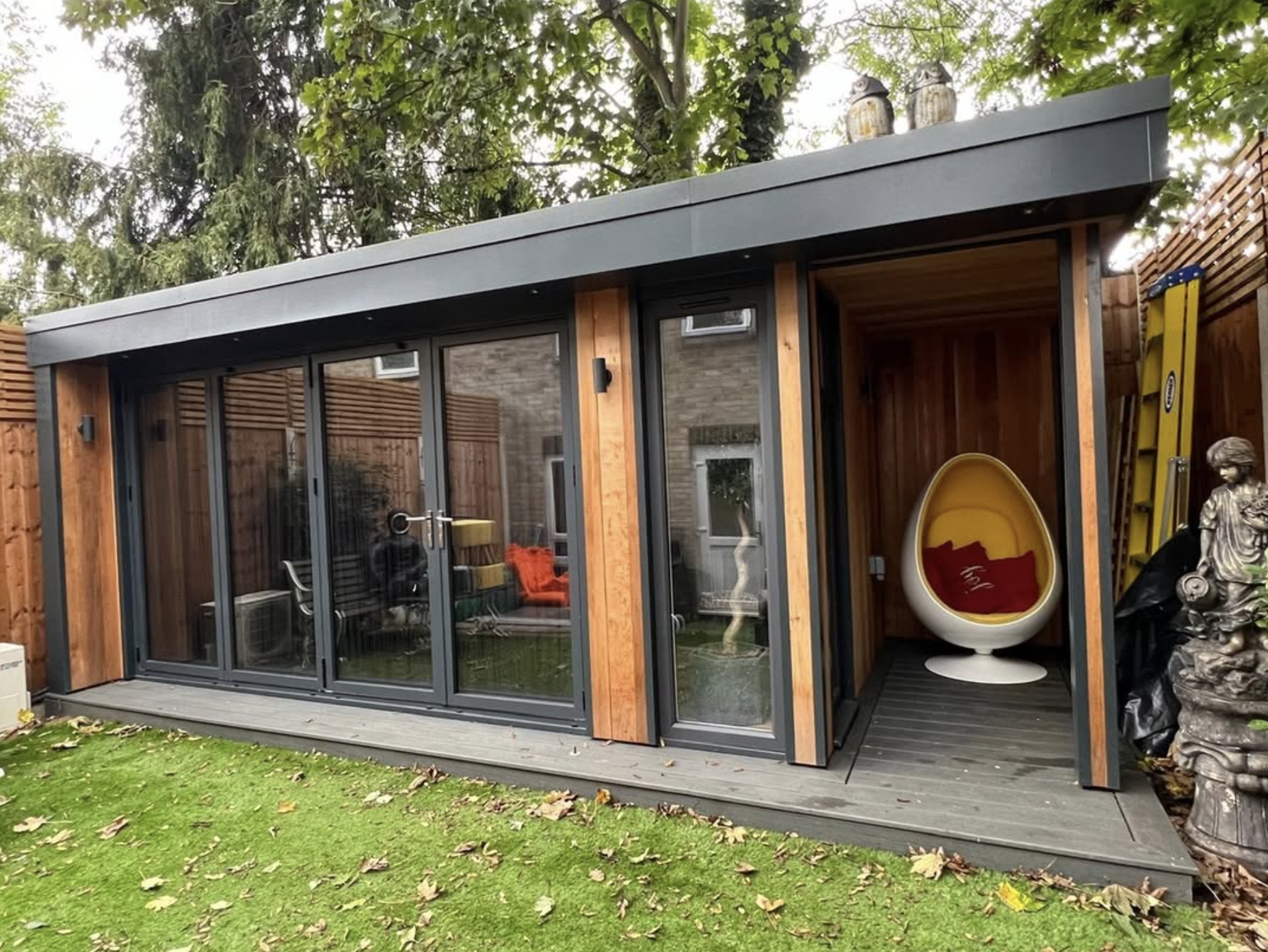
The Permitted Development Rules for Garden Rooms
There are seven main conditions your garden room must meet. Fail any single one and you will need to apply for planning permission.
1. Position: Not in Front of the House
Your garden room cannot be built forward of the principal elevation (the front wall) of the original house. In practice, this means back gardens and most side gardens are fine, but front gardens are not. If your property has an unusual layout where the “front” is not obvious, check with your local planning authority.
2. Single Storey Only
The building must be single storey. No mezzanines, no upper floors, no internal galleries that create a second level.
3. Maximum Height Limits
Height is where many people get caught out. The rules depend on roof type and proximity to the boundary:
- Dual pitched roof (apex/gable): maximum overall height of 4 metres, maximum eaves height of 2.5 metres.
- Any other roof type (flat, mono-pitch, curved): maximum overall height of 3 metres, maximum eaves height of 2.5 metres.
- Within 2 metres of any boundary: maximum total height of 2.5 metres regardless of roof type. This is the rule that catches most people. If your garden room sits close to a fence or neighbour’s boundary, the entire structure, from ground to the highest point of the roof, must not exceed 2.5 metres.
4. No More Than 50% Garden Coverage
The total area of ground covered by all outbuildings, extensions, sheds, and other additions must not exceed 50% of the total land area around the original house. “Original” means either as built, or as it stood on 1 July 1948, whichever is later. So if you already have a large extension and a shed, a garden room might tip you over the 50% limit.
5. No Verandas, Balconies, or Raised Platforms
Your permitted development garden room cannot include verandas, balconies, or raised platforms. Any decking or platform must not exceed 0.3 metres (roughly 30 cm) above ground level. A simple paved or composite deck area at ground level is fine, but anything raised beyond that threshold requires a separate planning application.
6. Not for Sleeping or Self-Contained Living
The building must be “incidental to the enjoyment” of the main house. It cannot be used as a separate self-contained dwelling or as primary sleeping accommodation. A home office, gym, music studio, art room, or garden bar are all acceptable. A self-contained granny annexe with its own kitchen and bedroom is a different matter and will almost certainly require planning permission.
A WC or small kitchenette within a garden office is generally considered incidental, as these support the main use rather than creating independent accommodation.
7. Special Rules for Designated Land
If your property falls within a National Park, Area of Outstanding Natural Beauty (AONB), the Broads, or a World Heritage Site, there are extra restrictions:
- No outbuilding on land between the side wall of the house and the boundary.
- Outbuildings more than 20 metres from any wall of the house are limited to a maximum of 10 square metres total ground coverage.
When Permitted Development Does NOT Apply
Permitted development rights are not universal. You will need to apply for full planning permission if any of the following apply to your property:
- Listed buildings: If your home is a listed building, you have no permitted development rights for outbuildings within the curtilage. You will need both planning permission and listed building consent.
- Flats and maisonettes: Permitted development rights under Class E only apply to houses. Flats and maisonettes are excluded entirely.
- Article 4 directions: Your local council can issue an Article 4 direction that removes specific permitted development rights. These are common in conservation areas but can apply anywhere. Check your local authority’s planning pages.
- Removed rights on new builds: Some newer housing estates have conditions attached to the original planning permission that remove permitted development rights. This is common where the council felt plots were already built out to capacity. Check your property’s planning history or title deeds.
If you are unsure whether your property has full permitted development rights, your local planning authority can confirm this. We also cover this in detail on our FAQ page.
Permitted Development vs Building Regulations
This is an important distinction that many articles muddle. Permitted development and building regulations are two separate things.
Permitted development decides whether you need planning permission. Building regulations decide whether your building must meet specific construction standards for safety, insulation, drainage, and electrical work.
Here is how building regulations apply to garden rooms:
- Under 15 square metres internal floor area: Building regulations do not normally apply, provided there is no sleeping accommodation.
- Between 15 and 30 square metres: Building regulations do not normally apply, provided there is no sleeping accommodation AND the building is either at least 1 metre from any boundary or constructed from substantially non-combustible materials.
- Over 30 square metres: Building regulations approval is required.
- Any sleeping accommodation: Building regulations apply regardless of size.
- Electrical work: Part P of the building regulations applies to all electrical installations in outbuildings, regardless of size.
Most of our bespoke garden rooms fall within the 15 to 30 square metre range, which keeps things straightforward for our customers.
Do You Need a Lawful Development Certificate?
A Lawful Development Certificate (LDC) is not required, but we strongly recommend getting one. It is a formal document from your local council confirming that your garden room is lawful under permitted development rules. It costs around £103 in England (or £206 if you apply after building), and the process usually takes six to eight weeks.
Why bother? Because when you come to sell your property, a buyer’s solicitor will ask about any structures in the garden. An LDC removes any doubt and avoids delays during conveyancing. It is a small cost for real peace of mind.
A Quick Checklist Before You Build
Before committing to a permitted development garden room, run through these questions:
- Is your property a house (not a flat or maisonette)?
- Is it not a listed building?
- Have permitted development rights been removed by an Article 4 direction or planning condition?
- Will the garden room be behind the front wall of the house?
- Will the total height stay within the limits for your roof type and boundary distance?
- Will total outbuilding coverage remain under 50% of the garden area?
- Will the room be used for purposes incidental to the house (office, gym, studio) and not as a bedroom or self-contained flat?
If you answered yes to the first question and no to the third, and yes to the rest, you are almost certainly fine to build under permitted development.
What Size Garden Room Can You Build?
There is no maximum floor area for a permitted development garden room, as long as the total coverage of all outbuildings stays under 50% of the garden. The height limits and boundary rules are the real constraints.
For most gardens in South East London, Kent, and Surrey, our customers typically choose rooms in the range of 12 to 25 square metres. Our Midi, Maxi, and Multi ranges all fit comfortably within permitted development for the vast majority of properties. You can see our full range and garden room prices here.
We Handle the Details for You
At Garden Office Buildings, we deal with permitted development rules on every single project. After more than 1,000 builds since 2004, we know these regulations inside out. We assess your garden, confirm your permitted development rights, and design your garden room to comply fully. If your project does need planning permission for any reason, we handle the application on your behalf.
If you have questions about what you can build in your garden, get in touch and we will give you a straight answer.
Save £5,000 with Our Ambassador Programme
If you would like to save money on your garden room, ask us about our Ambassador Programme. Ambassadors allow us to use their build for photography and a few viewing visits, and in return they save £5,000 off the price. It is a simple arrangement that benefits both sides.