

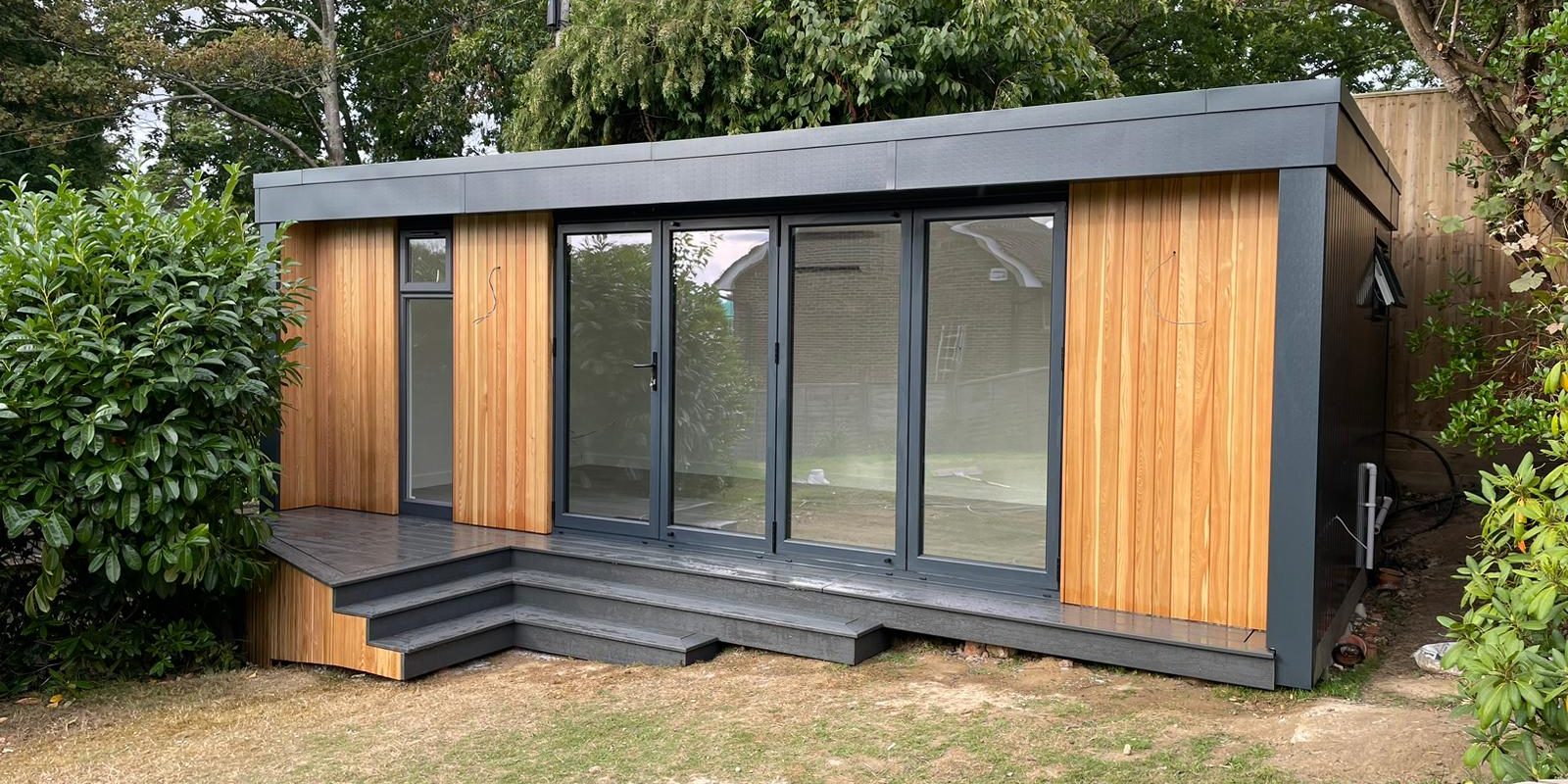
A garden room built for a golf simulator is one of the most exciting projects we get asked about. The idea is simple: a dedicated space at the bottom of your garden where you can practise your swing year round, play famous courses on screen, and avoid the four-hour round trip to the club on a rainy Saturday. But getting it right takes careful planning, because a golf sim garden room has specific requirements that a standard garden office does not.
We have been building garden rooms across South East London, Kent, Surrey, and Sussex since 2004, with over 1,000 builds behind us. In that time we have seen the demand for golf simulator rooms grow rapidly. This guide covers everything you need to know before committing, from dimensions and ceiling height to equipment costs and planning permission.
Table of Contents
- Room Dimensions: Height, Width, and Depth
- Why Ceiling Height Is the Biggest Challenge
- Planning Permission and Permitted Development
- Golf Simulator Equipment: What You Need
- Launch Monitors and Space Requirements
- How Much Does a Golf Simulator Garden Room Cost?
- Power, Internet, and Electrical Requirements
- Insulation, Heating, and Ventilation
- Flooring for a Golf Simulator Room
- Getting Started
Room Dimensions: Height, Width, and Depth
Golf simulator rooms need more space than most people expect. You are swinging a driver at full speed in an enclosed room, so there is no room for compromise on dimensions.
Ceiling Height
This is the single most important measurement. You need a minimum internal ceiling height of 2.7 metres (just under 9 feet) to swing a driver without hitting the ceiling. For taller golfers (over six feet), 3 metres (10 feet) is strongly recommended. When a golfer is even slightly aware of the ceiling above them, their swing changes, affecting club speed, attack angle, and shot consistency.
Width
The minimum practical width is 3 metres. This allows a single right-handed or left-handed golfer to swing comfortably. If you want the flexibility to accommodate both right-handed and left-handed players, or you simply want a more comfortable feel, aim for 4 to 4.5 metres. This also gives you room for a seating area to one side, which makes the space more sociable.
Depth (Length)
Depth is determined by three things: the space you stand in, the distance from ball to impact screen, and the space needed behind you for the launch monitor. The absolute minimum depth is around 4.5 metres, but 5.5 to 6 metres is far more practical. If you are using a radar-based launch monitor like Trackman, you may need closer to 6 or 7 metres because the unit sits well behind the golfer.
Recommended Minimum Dimensions
| Measurement | Minimum | Recommended | Ideal |
|---|---|---|---|
| Ceiling height | 2.7m | 3.0m | 3.2m+ |
| Width | 3.0m | 4.0m | 4.5m+ |
| Depth | 4.5m | 5.5m | 6.0m+ |
For a comfortable golf sim garden room, we would suggest a floor area of at least 18 to 24 square metres. That puts you in the territory of our Multi or Multi+ buildings, both of which can be adapted for golf simulator use with the right specification.
Why Ceiling Height Is the Biggest Challenge
Here is the issue that catches most people out. Under permitted development rules in England, outbuildings are limited to a maximum eaves height of 2.5 metres. A standard garden room built to these limits will have an internal ceiling height of roughly 2.3 to 2.4 metres once you account for the floor build-up, insulation, and ceiling finish. That is not tall enough for a golf swing.
Even at the theoretical maximum of 2.5 metres internally, most golfers over 5 foot 8 will hit the ceiling with a driver on a full backswing. The numbers simply do not work for a standard height garden room.
So how do you get the height you need?
Option 1: Position the building 2 metres from all boundaries
If your garden room is sited at least 2 metres from every boundary, the permitted development rules allow a dual pitched roof with a maximum overall height of 4 metres. That gives you a ridge height high enough to achieve 3 metres or more of internal ceiling height in the centre of the room, which is exactly where you will be standing to swing. This is the most common solution and works well in larger gardens.
Option 2: Apply for planning permission
If your garden layout means you cannot position the building 2 metres from all boundaries, or you need a flat roof design, you will likely need planning permission to exceed the 2.5-metre eaves restriction. Planning applications for garden rooms are generally straightforward. The fee in England is currently around £528 plus the Planning Portal charge. Most councils decide within eight weeks.
Option 3: Lower the floor level
Some homeowners dig down to lower the finished floor level, gaining extra internal height without increasing the external height of the building. This works but adds significant cost for excavation, waterproofing, drainage, and steps. It is worth considering if other options are not available, but it is not the simplest route.
We discuss all of this during the design stage with every customer. If you are considering a golf simulator room, a bespoke garden room designed around your specific garden layout and the height you need is the best approach.
Planning Permission and Permitted Development
Beyond the height issue, a golf simulator garden room must meet the same permitted development criteria as any other outbuilding:
- Single storey only
- Must not cover more than 50% of the total garden area
- Maximum eaves height of 2.5 metres (or higher if 2 metres from boundaries, as described above)
- Maximum overall height of 4 metres with a dual pitched roof, or 3 metres for any other roof type
- Must not be used as self-contained living accommodation
- Additional restrictions apply in conservation areas, national parks, and for listed buildings
A golf simulator room used for personal recreation fits within permitted development, as long as the physical dimensions comply. It is treated the same as a home gym or hobby room.
If you are in any doubt, we always recommend checking with your local planning authority before work begins. Pre-application advice is inexpensive and gives you certainty.
Golf Simulator Equipment: What You Need
Once the room is built, you need to fill it with the right equipment. A complete golf simulator setup has several components:
Launch Monitor
This is the brain of the system. It tracks your club and ball data (speed, spin, launch angle, carry distance) and sends it to the software. Launch monitors range from around £500 for entry-level units to £20,000+ for professional-grade systems.
Impact Screen
A durable fabric screen that the ball hits. It also doubles as the projection surface for the course visually. Good impact screens cost between £300 and £1,500 depending on size and material.
Projector
A short-throw projector is essential for a garden room because it can sit close to the screen without the golfer casting a shadow. Budget £500 to £3,000 depending on resolution and brightness. Short-throw models with a throw ratio between 0.5 and 1.1 work best in compact spaces.
Hitting Mat
A quality hitting mat protects the floor and gives you a realistic turf feel. Expect to pay £200 to £1,000. Cheaper mats wear out quickly and can cause joint strain.
Enclosure Frame
The frame that holds the impact screen and side netting to contain errant shots. Basic frames start at around £250, while full commercial-grade enclosures with side panels and ceiling baffles can run to £5,000.
Computer or Tablet
Most simulators need a PC or laptop to run the software. A capable gaming PC costs £1,000 to £3,000. Some entry-level systems (like the SkyTrak) can run from a tablet or smartphone, which keeps costs down.
Software
Simulator software gives you access to virtual courses, driving ranges, and game modes. Popular options include E6 Connect, TGC 2019, and GSPro. Expect annual subscription costs of £200 to £1,200, or one-off licence fees for some platforms.
Launch Monitors and Space Requirements
The type of launch monitor you choose directly affects how much room depth you need. This is a detail many people overlook until the equipment arrives.
Camera-Based Systems (Less Depth Needed)
Camera-based launch monitors sit beside or just in front of the ball. They photograph the ball at impact and calculate its flight from that data. Because they do not need space behind the golfer, they work well in shorter rooms.
Popular camera-based options include:
- SkyTrak / SkyTrak+ (from around £2,000): Sits beside the ball. Works in rooms as short as 3.7 metres, though 5 metres is more comfortable.
- Foresight GC3 / GCQuad (from around £5,000 to £12,000): Professional-grade accuracy. Needs roughly 3 metres of depth minimum, with 4 metres preferred.
- Uneekor EYE XO / QED (from around £4,000 to £8,000): Ceiling-mounted units that look down at the ball. Need minimal floor space but require secure ceiling mounting.
Radar-Based Systems (More Depth Needed)
Radar-based monitors sit behind the golfer and track the ball through its full flight. They need significantly more room depth.
- Trackman 4 / Trackman iO (from around £17,000): Needs a minimum of 5 metres from the radar unit to the screen, with 5.5 metres or more recommended. This means total room depths of 6 to 7 metres.
- FlightScope X3 / Mevo+ (from around £2,000 to £8,000): The Mevo+ is more compact than Trackman but still benefits from 5 metres of depth.
For most garden room golf simulators, a camera-based system is the practical choice. It costs less, needs less depth, and still delivers accurate shot data for practice and entertainment.
How Much Does a Golf Simulator Garden Room Cost?
This is the question everyone wants answered. The total cost breaks down into two parts: the building itself and the simulator equipment inside it.
The Garden Room
A bespoke garden room sized and specified for a golf simulator will typically cost between £25,000 and £50,000 depending on size, ceiling height, and finish level. A room at the smaller end (around 18 square metres with a vaulted ceiling reaching 3 metres) sits at the lower end of that range. A larger room (24 to 30 square metres with premium finishes) will be towards the upper end.
On top of the building cost, budget for the electrical connection from your house (£1,500 to £3,500), landscaping and reinstatement (£500 to £2,000), and a contingency of 5% to 10%.
The Simulator Equipment
| Budget Level | Equipment Cost | What You Get |
|---|---|---|
| Entry-level | £2,000 to £5,000 | Budget launch monitor, net or basic screen, hitting mat, tablet-based software |
| Mid-range | £5,000 to £15,000 | Accurate launch monitor (SkyTrak+ or similar), quality impact screen, short-throw projector, PC, enclosure frame |
| Premium | £15,000 to £30,000+ | Professional launch monitor (Foresight GCQuad or Trackman), high-end projector, commercial enclosure, premium hitting mat, full software suite |
Total Project Costs
| Setup Level | Building | Equipment | Extras | Total |
|---|---|---|---|---|
| Good | £25,000 | £5,000 | £3,000 | £33,000 |
| Very good | £35,000 | £12,000 | £3,500 | £50,500 |
| Premium | £45,000 | £25,000 | £4,000 | £74,000 |
Most of our customers building golf simulator rooms land somewhere in the £35,000 to £55,000 range for the complete project. That includes the building, a solid mid-range simulator, and all the associated costs.
Power, Internet, and Electrical Requirements
A golf simulator garden room needs a reliable electrical supply and a good internet connection. Here is what to plan for.
Power
Your simulator equipment will draw a fair amount of power. A projector uses 200 to 500 watts, a gaming PC adds another 300 to 800 watts, and your launch monitor, lighting, and heating add more on top. We recommend a dedicated electrical circuit from your house to the garden room, installed by a qualified electrician with a Part P certificate.
A minimum of four double sockets in the simulator area is sensible, plus additional sockets for heating and any other equipment. Surge protection is worth fitting to protect your projector and computer from power spikes.
Internet
You can use most golf simulators offline for basic practice. But for online multiplayer, software updates, and access to the full library of virtual courses, you need a stable internet connection. Wi-Fi from the house may work if the garden room is close, but signal strength drops quickly through walls and across distance. A dedicated Wi-Fi extender, mesh network node in the garden room, or (best of all) a direct ethernet cable run alongside the power cable will give you the most reliable connection.
Insulation, Heating, and Ventilation
If you are spending thousands on simulator equipment, you need the room to protect it. Temperature swings, condensation, and damp are the enemies of electronics and projector lamps.
Insulation
Full insulation in the walls, floor, and roof is not optional for a golf simulator room. Our builds use 100mm PIR insulation as standard, which keeps the internal temperature stable and prevents condensation forming on cold surfaces. This also protects your equipment during winter months when the room may not be in daily use.
Heating
Swinging a golf club generates body heat, so you may not need much heating during use. But you do need to keep the room above a baseline temperature to prevent damp and protect electronics. An electric panel heater with a frost protection setting works well. For year-round comfort, an air conditioning unit that provides both heating and cooling is ideal, especially in summer when a well-insulated room with a projector running can get warm.
Ventilation
Good airflow matters. A couple of openable windows or trickle vents will handle basic ventilation. If the room is fully sealed during use (to keep light off the screen), consider a small mechanical ventilation unit to keep fresh air circulating.
Flooring for a Golf Simulator Room
The floor needs to handle repeated impact from golf swings and dropped clubs while being comfortable to stand on for extended sessions.
The most popular approach is a combination of hard-wearing rubber or vinyl flooring across the room, with a quality hitting mat in the tee position. Some customers lay artificial turf around the hitting area for a more authentic feel, with rubber matting or tiles elsewhere. Avoid anything too soft or spongy, as it will affect your footing and stance.
Whatever surface you choose, make sure the subfloor is solid and level. Any unevenness will be noticeable when you are standing over a golf ball.
Getting Started
A golf simulator garden room is a serious project, but the result is something you will use for years. The key steps are:
- Measure your garden and work out where the building can sit, paying close attention to boundary distances (you will almost certainly need the 2-metre setback to achieve the height required).
- Decide on your ceiling height requirement based on the tallest person who will use it.
- Choose your launch monitor type early, because this determines the room depth you need.
- Talk to us about a bespoke design that gives you the exact dimensions, ceiling height, and specification you need.
- Get the electrical and internet infrastructure planned at the same time as the building design, so cables can be routed cleanly.
We are happy to talk through your plans and help you work out what is realistic for your garden, your budget, and your golf game. Visit our contact page to get in touch.
Save £5,000 with Our Ambassador Programme
If a golf simulator garden room is on your list, our Ambassador Programme is worth knowing about. Ambassadors allow us to photograph their finished garden room and share a short case study on our website. In return, you save £5,000 on your build. It is a simple arrangement that has helped hundreds of customers reduce the cost of their project. If you are happy for us to showcase the finished result, it is the easiest way to bring your budget down.