

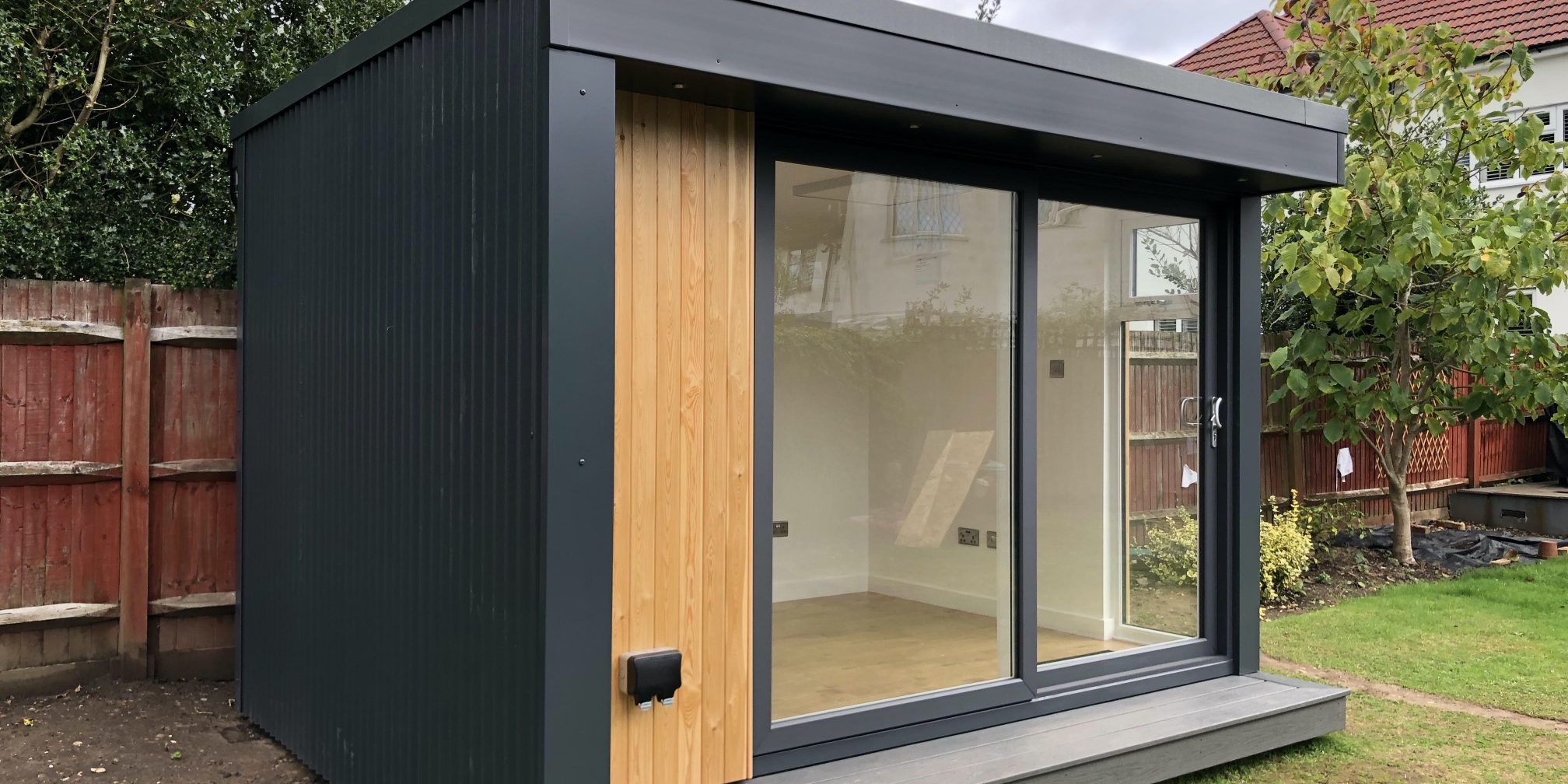
A granny annexe garden room gives an elderly parent or relative their own front door, their own kitchen, their own bathroom, and their own living space, all within a few steps of your back door. It keeps families close without forcing anyone to give up their independence. And in a country where the average residential care home now costs upwards of £67,000 a year, it is an option that makes real financial sense too.
We have been building garden rooms across South East London, Kent, Surrey, and Sussex since 2004. Over the past few years, granny annexe builds have become one of our fastest growing project types. More families are choosing to care for parents at home rather than face the cost, waiting lists, and emotional toll of residential care. Here is everything you need to know about making it work.
What Makes a Garden Room Annexe “Self-Contained”?
In planning terms, a self-contained annexe is a building that has everything a person needs to live independently. That means a bedroom (or combined living and sleeping space), a kitchen or kitchenette, a bathroom with a toilet, and its own entrance. The occupant can eat, sleep, wash, and come and go without relying on the main house for any basic daily function.
This is different from a garden room that happens to have a sofa bed in it, or an outbuilding with a microwave and a camping toilet. Those are “incidental” to the main house. A proper granny annexe garden room is designed from the ground up as a place someone can live day in, day out, with comfort and dignity.
The distinction matters because it affects planning permission, building regulations, and council tax. We will cover each of those below.
Planning Permission: Do You Need It?
In almost every case, yes. This is the single most important thing to understand before you start planning a garden room annexe.
Under permitted development rules (Class E of the General Permitted Development Order), you can build an outbuilding in your garden without planning permission, provided it meets certain size and placement limits. However, the rules are clear that permitted development covers buildings used for purposes “incidental to the enjoyment of the dwelling house.” The government’s own guidance states that a new building must not itself be “separate, self-contained, living accommodation.”
A granny annexe with a bedroom, bathroom, and kitchen is, by definition, self-contained living accommodation. That takes it outside permitted development. You will need to submit a householder planning application to your local council.
This is not something to worry about. Planning applications for granny annexes are approved regularly, provided the design is sympathetic to the existing property and surrounding area. Councils generally look favourably on annexes that keep families together and reduce pressure on social care services. The current application fee for a householder planning application in England is £293, and you can expect a decision within eight weeks.
Ancillary vs Independent: The Key Test
When assessing your application, the council will want to be satisfied that the annexe will be “ancillary” to the main dwelling, not a separate, independent home. This means the occupant should have a genuine connection to the household in the main house (typically a parent, grandparent, or close family member), the annexe should share the same postal address and garden as the main house, it should not be sold or let separately from the main property, and it should not have its own separate utility meters or council tax billing unless the council specifically requires it.
In practice, planning officers are looking for evidence that the annexe and the main house function as one household, not two. A condition is often attached to the planning consent restricting the use to “ancillary residential accommodation” and preventing it from being used as an independent dwelling or rental property.
For a detailed look at how planning works for garden buildings, see our planning permission and building regulations guide.
Building Regulations for a Habitable Annexe
Planning permission is about whether you can build it. Building regulations are about how you build it. A self-contained granny annexe must meet the full range of Building Regulations because it is classed as habitable accommodation. This is a higher bar than a standard garden office or hobby room, and rightly so. Someone is going to live in this building, potentially for years.
The key parts of the Building Regulations that apply to a granny annexe are as follows.
Part L: Insulation and Energy Efficiency
The annexe must meet current thermal performance standards. Walls, roof, and floor all need to achieve specified U-values, which measure how much heat escapes through the building fabric. For new buildings, walls typically need a U-value of 0.26 W/m2K or better, and the roof needs 0.18 W/m2K or better. Windows must be double glazed at minimum, and the overall energy performance must meet the 2021 revised standards aimed at reducing carbon emissions from new buildings by around 30%.
This is one area where a well-built garden room really shines. Our builds use high-performance insulation throughout, and many of our customers tell us their annexe is warmer than their main house.
Part B: Fire Safety
A building where someone sleeps has stricter fire safety requirements than a daytime-only workspace. Your granny annexe will need interlinked smoke detectors in the living areas, a heat detector in the kitchen, fire-resistant construction where required (including 30-minute fire-rated plasterboard), and a clear means of escape, usually a window or door that opens directly to outside at ground level.
Because most garden room annexes are single-storey buildings at ground level, the escape requirements are generally straightforward to meet.
Part M: Accessibility
Part M covers access to and use of the building. For a granny annexe designed for an elderly relative, this is especially important. The requirements include level or ramped access to the entrance (no steps), door widths of at least 775mm clear opening, a bathroom designed to accommodate someone with reduced mobility, and corridors and circulation space wide enough for a walking frame or wheelchair.
Even if your parent is perfectly mobile today, it makes sense to design the annexe with future needs in mind. Wider doors, a level-access shower, grab rails in the bathroom, and a layout that could accommodate a wheelchair all cost very little extra at the build stage but can be extremely expensive to retrofit later.
Parts G, H, F, and P
These cover sanitation and hot water, drainage and waste disposal, ventilation, and electrical safety respectively. In practical terms, this means properly installed plumbing with temperature-controlled hot water, drainage connected to the mains sewer with correct gradients and sealed joints, mechanical ventilation in the bathroom and kitchen, and all electrical work carried out by a qualified, registered electrician.
Building control will inspect the work at key stages and issue a completion certificate when the annexe meets all requirements. This certificate is important. Without it, you may have difficulties selling your property in the future, and your home insurance could be affected.
Council Tax: What Will You Pay?
Council tax on a granny annexe is an area where many families worry unnecessarily. The rules are more generous than most people expect.
Full Exemption
Your annexe may be completely exempt from council tax if it is occupied by a dependent relative who is aged 65 or over, severely mentally impaired, or substantially and permanently disabled. An unoccupied annexe can also be exempt if planning conditions prevent it from being sold or let separately from the main house.
50% Discount
Since April 2014, annexes that are occupied by a relative of the person living in the main house, or used by the main house occupier as part of their home, qualify for a 50% reduction in council tax. This discount applies on top of any other discount the occupant may be entitled to, such as a single person discount.
No Separate Band
If the annexe is not self-contained (for example, it has a bedroom and bathroom but no kitchen, and the occupant uses the main house kitchen), it may not be separately banded at all. In that case, it is treated as part of the main property and there is no additional council tax.
The exact treatment depends on your local council’s valuation office, so it is always worth checking with them early in the process. But the overall picture is encouraging. The government specifically introduced the 50% annexe discount to support families who want to keep elderly relatives close to home.
The Financial Case: Annexe vs Care Home
The numbers here are striking. The average cost of a residential care home in the UK is now approximately £1,300 per week for a self-funded place. That works out to roughly £67,600 per year. Nursing care averages around £1,535 per week, or about £79,800 per year. Specialist dementia care can exceed £1,800 per week.
A well-specified, self-contained granny annexe garden room typically costs between £80,000 and £130,000 depending on size, specification, and site conditions. Even at the top end of that range, the annexe pays for itself within two years compared to residential care fees. After that, the ongoing costs are limited to utilities, maintenance, and any care support your parent needs at home.
There are also financial benefits that extend beyond the direct cost saving. A granny annexe typically adds 20% to 30% to the value of your property, according to multiple industry studies. For an average home in our area, that could mean an additional £60,000 to £100,000 in property value. The annexe also frees up your parent’s former home for sale or rental, which can provide additional funds to cover care costs or simply strengthen the family’s financial position.
The Family Case: Why Proximity Matters
The financial argument is compelling, but for most of our customers, money is not the primary reason they build a granny annexe. It is about family.
Having a parent living in an annexe in your garden means you can pop in every morning with a cup of tea, share meals when everyone feels like it, and keep an eye on things without being intrusive. Your children grow up with their grandparents nearby. Your parent stays connected to daily family life rather than sitting alone in a care home waiting room.
At the same time, the self-contained nature of a proper annexe means everyone keeps their own space. Your parent has their own kitchen, their own sitting room, their own routine. They are not sleeping in your spare bedroom or sharing your bathroom. The arrangement works precisely because it balances closeness with independence.
Under the Care Act 2014, local authorities have a duty to assess the needs of anyone who appears to need care and support. That assessment is free and should consider the person’s living situation as part of the overall picture. A parent living in a well-designed annexe with family nearby may need far less formal care than one living alone in a house that is too big for them or in a care home where they are unhappy. Home-based care, supported by a carer’s assessment, can also unlock practical help such as assistive technology, respite care, and personal assistants funded through the local authority.
Design Considerations for a Granny Annexe
A granny annexe is not just a small house in your garden. It needs to be designed specifically for the person who will live in it, with thought given to both their current needs and how those needs might change over the next 5, 10, or 15 years.
Size and Layout
Most of our granny annexe builds fall in the range of 30 to 50 square metres. A typical layout includes an open-plan living and kitchen area, a separate bedroom, a bathroom with level-access shower, and a small entrance hall or porch. At 40 square metres, this is genuinely comfortable, not cramped.
For couples, or where more space is needed, we build annexes up to 60 or 70 square metres with two bedrooms, a larger kitchen, and additional storage.
Heating and Comfort
Elderly people feel the cold more acutely, so heating design is critical. We typically install an air source heat pump or electric underfloor heating, both of which provide even, controllable warmth without the bulk of radiators. Good insulation means the heating system does not have to work hard, which keeps running costs low.
Safety Features
Practical safety features include level thresholds at all doors, non-slip flooring in the bathroom and kitchen, lever-style door handles (easier than round knobs for arthritic hands), good lighting throughout with no dark corners, a video doorbell or intercom linked to the main house, and emergency pull cords in the bathroom and bedroom.
Future-Proofing
Even if your parent is fit and active today, building with the future in mind saves significant cost and disruption later. Wider doorways, a wet room instead of a shower cubicle, reinforced bathroom walls for future grab rails, and space for a hospital-style bed in the bedroom all cost very little extra during the initial build.
We design every granny annexe as a bespoke project tailored to the specific needs of your family. No two are the same.
The Build Process
A granny annexe garden room follows the same general build process as our other garden rooms, with a few additional steps.
- Site visit and design consultation. We visit your property, assess the site, discuss your parent’s needs, and draw up initial designs. This is free and without obligation.
- Planning application. We prepare and submit the planning application on your behalf, including all necessary drawings and supporting documents. Most applications are decided within eight weeks.
- Building regulations application. Submitted alongside or shortly after the planning application. Building control will review the design and confirm the inspection stages.
- Groundworks and foundations. Concrete pad or screw pile foundations depending on the site. Service trenches for water, drainage, and electrics are dug at this stage.
- Structure, insulation, and weatherproofing. The timber frame structure goes up, followed by insulation, vapour barriers, external cladding, and roofing.
- Internal fit-out. Kitchen, bathroom, electrics, plumbing, plastering, flooring, and decoration.
- Building control sign-off. Final inspection and completion certificate.
The typical build time for a granny annexe is 8 to 12 weeks from the start of groundworks, depending on size and complexity. The planning application period runs before this, so allow 4 to 6 months from initial enquiry to moving in.
For a full overview of pricing across our range, visit our buildings and prices page.
Common Questions
Can I rent out a granny annexe?
Not if it was granted planning permission as ancillary accommodation. The planning consent will typically include a condition restricting its use to a family member and preventing independent letting. If you want to rent the space out, you would need to apply for a change of use to create a separate dwelling, which is a different type of planning application with different considerations.
What happens when my parent no longer needs the annexe?
The building remains a valuable asset. Many families convert the annexe into a home office, guest suite, or teenage den. You could also apply to vary the planning condition to allow rental use, subject to council approval. Either way, a well-built annexe adds significant value to your property.
Do I need a separate address and postbox?
No. An ancillary annexe shares the postal address of the main house. It does not get its own separate address, and you should not register it as a separate property. This helps maintain its status as ancillary accommodation rather than an independent dwelling.
Can I build an annexe in a conservation area?
Yes, but permitted development rights are more restricted in conservation areas, and design requirements may be stricter. You will almost certainly need planning permission, and the design may need to use specific materials or match the architectural style of the area. We have experience building in conservation areas across Kent, Surrey, and Sussex and can guide you through the process.
Save £5,000 with Our Ambassador Programme
If you are planning a granny annexe garden room, our Ambassador Programme can save you £5,000 on the total cost. In return, you allow us to photograph the completed build and host a small number of viewing visits for prospective customers. It is a straightforward arrangement that has helped hundreds of families get a better build for less. Get in touch to find out if your project qualifies.