

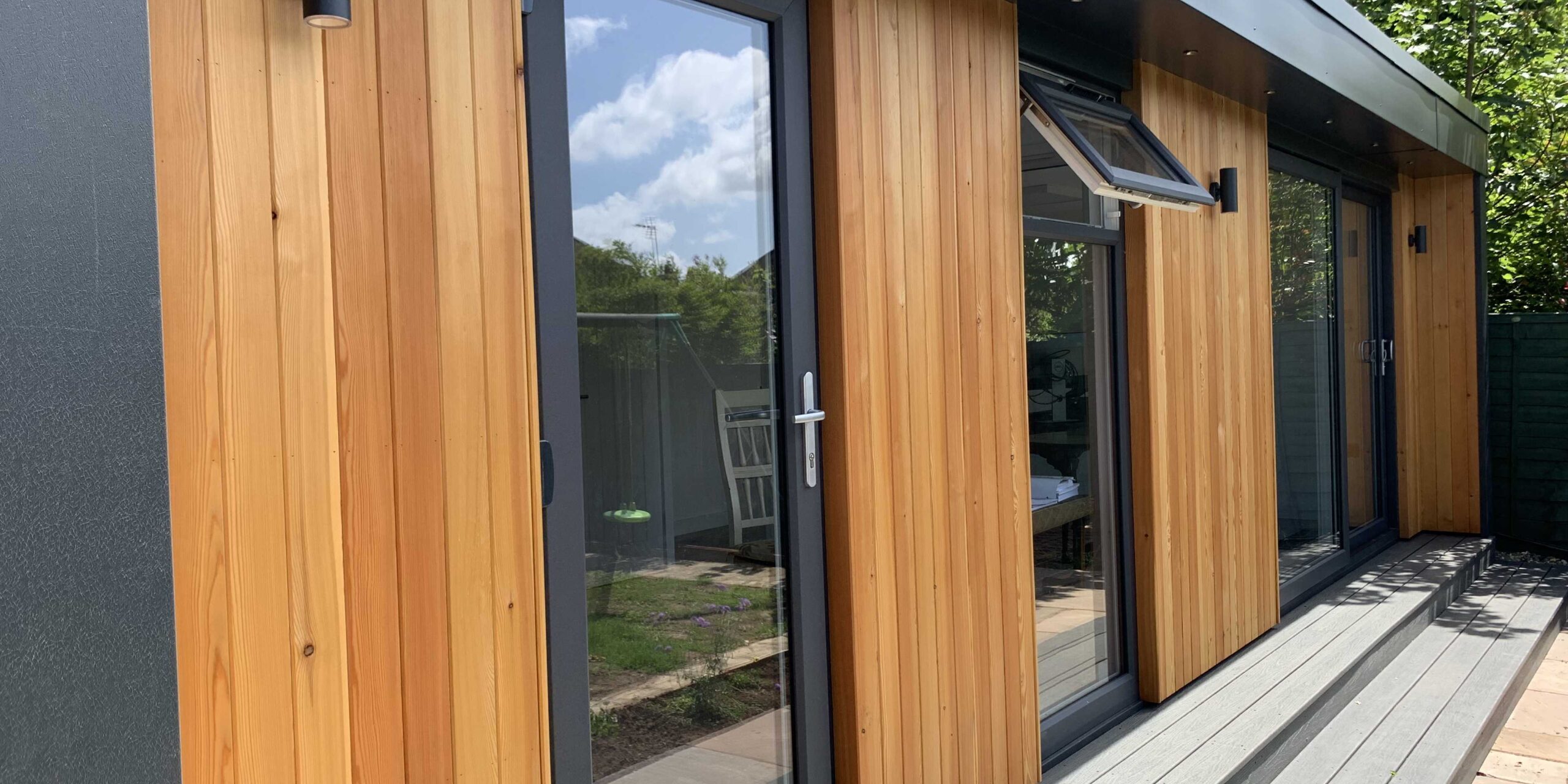
Playing drums at ten o’clock on a Tuesday evening. Running through vocal takes at full volume on a Sunday morning. Mixing a track with monitors cranked up and not worrying about the neighbours. That is what a properly soundproofed garden room gives you. Freedom to make music on your own terms, at any hour, without complaints.
We have been building garden rooms across South East London, Kent, Surrey, and Sussex since 2004. Over those years, a growing number of our builds have been for musicians, producers, podcasters, and bands who need a dedicated space that keeps sound in and the outside world out. This guide covers everything you need to know about creating a soundproof garden room for music practice and recording, from the materials and construction methods to realistic costs and the mistakes to avoid.
Sound Insulation vs Acoustic Treatment: Two Different Jobs
Before getting into the detail, it is worth understanding the difference between soundproofing and acoustic treatment. They are not the same thing, and you almost certainly need both.
Sound insulation (soundproofing) stops sound from passing through walls, floors, ceilings, windows, and doors. It keeps your music inside the room and prevents external noise from getting in. This is achieved through mass, isolation, and airtight construction.
Acoustic treatment controls how sound behaves inside the room. It reduces echo, flutter, and standing waves so that what you hear while playing or recording is clean and accurate. Foam panels, bass traps, and diffusers are typical acoustic treatment products. They make the room sound better to be in, but they do almost nothing to stop sound escaping through the walls.
A garden room lined with foam panels might sound great inside, but your neighbours will still hear everything. Equally, a perfectly soundproofed room with no acoustic treatment will sound boomy and harsh inside, which is useless for recording. You need to address both, and the soundproofing must be designed into the structure from the start. It cannot be bolted on after the build.
How Soundproofing Is Measured
Sound reduction is measured in decibels (dB). The higher the number, the more sound is blocked. In the UK, Building Regulations require walls between separate homes to achieve at least 45 dB of airborne sound reduction. For a music room, you want to match or exceed that.
Here is a quick reference for common instrument volumes.
| Sound Source | Typical Volume |
|---|---|
| Quiet library | 30 dB |
| Normal conversation | 60 dB |
| Acoustic guitar | 70 to 80 dB |
| Piano | 70 to 85 dB |
| Electric guitar (amplified) | 80 to 100 dB |
| Drum kit | 90 to 120 dB |
If your drum kit peaks at 110 dB and your garden room achieves 55 dB of sound reduction, the sound reaching outside will be around 55 dB. That is roughly the level of a normal conversation, which is unlikely to cause any issues with neighbours, even late at night. For quieter instruments like acoustic guitar or piano, a reduction of 40 to 45 dB is usually more than enough.
What Level of Soundproofing Can a Garden Room Achieve?
A well built garden room with enhanced insulation and acoustic glazing will typically achieve 30 to 35 dB of sound reduction. That is fine for a home office or quiet hobby room, but it will not contain amplified music or drums.
With dedicated soundproofing materials and construction techniques, a garden music room can realistically achieve 40 to 55 dB of reduction. A full room within a room build, the gold standard for music studios, can push that to 55 to 60 dB. At that level, even a loud drum kit becomes barely noticeable from outside.
The level you need depends on what you play, how loud you play it, how close your neighbours are, and what times you want to practise. We work through all of this during the design stage so the specification matches your actual requirements.
The Four Principles of Soundproofing
Every effective soundproofing system relies on four things working together. Miss any one of them and the performance drops significantly.
1. Mass
Heavy, dense materials block sound waves. The heavier the wall, floor, or ceiling, the harder it is for sound energy to pass through. This is why a brick wall blocks more sound than a plasterboard partition. In a garden room, mass is added through multiple layers of acoustic plasterboard, mass loaded vinyl (MLV), and dense mineral wool insulation. Two layers of 15mm acoustic plasterboard on each wall face is a common starting point.
2. Absorption
Mineral wool acoustic insulation, fitted between wall studs and ceiling joists, absorbs sound energy as it passes through the wall cavity. This is different from standard thermal insulation. Acoustic grade mineral wool (such as Rockwool Flexi Slab at 60 to 100mm thickness) is denser and specifically designed to absorb sound frequencies. Standard thermal insulation does reduce some noise, but it is primarily designed for temperature control and will not deliver serious sound reduction on its own.
3. Isolation (Decoupling)
This is where the real gains happen. If the inner wall surface is physically connected to the outer structure, sound vibrations travel straight through. Resilient bars, isolation clips, and independent stud walls break that connection. Resilient bars are thin steel channels fixed horizontally across timber studs, with plasterboard screwed to the bars rather than directly to the studs. They act as shock absorbers, preventing vibrations from transferring through the structure. Fitting resilient bars with a double layer of acoustic plasterboard and 100mm of Rockwool between the studs can add around 16 dB of improvement over a basic wall.
4. Sealing
Sound behaves like water. It will find and exploit the smallest gap. Every joint, edge, penetration, socket box, pipe run, and vent is a potential weak point. Acoustic sealant (a flexible, non hardening mastic) is used around all edges where plasterboard meets walls, floors, and ceilings. Neither layer of plasterboard should touch the surrounding structure directly. Even a 2mm gap left unsealed can undo a significant portion of the soundproofing work.
Room Within a Room: The Gold Standard
For serious music practice and recording, particularly with drums, amplified instruments, or band rehearsals, the most effective approach is a room within a room. This means building an entirely separate inner shell inside the garden room’s outer structure. The inner walls, floor, and ceiling do not touch the outer ones. Instead, they sit on isolation mounts and are separated by an air gap.
A typical room within a room build up for a garden music room looks like this.
Walls (outside to inside):
- Outer cladding and weather membrane
- Structural timber frame with thermal insulation
- Outer sheathing board
- Air gap (25 to 50mm)
- Independent inner stud wall on isolation mounts
- 100mm acoustic mineral wool between inner studs
- Mass loaded vinyl layer
- Resilient bars fixed to inner studs
- Two layers of 15mm acoustic plasterboard
- All edges sealed with acoustic sealant
Floor:
- Structural floor deck
- Isolation pads or rubber cradles
- Independent floating floor frame (not touching the walls)
- Acoustic mineral wool between floor joists
- Two layers of high density board
- Finished floor surface
Ceiling:
- Roof structure with thermal insulation
- Air gap
- Isolation clips or resilient bars
- Acoustic mineral wool
- Two layers of acoustic plasterboard
This approach is the most effective way to achieve 50 dB or more of sound reduction, but it does come at a cost. The inner shell takes up space (typically 100 to 150mm on each wall, plus floor and ceiling depth), so the garden room needs to be larger to start with to leave enough usable space inside.
Windows and Doors: The Weak Points
You can build the most impressive walls in the world, but if your windows and doors are standard units, sound will pour straight through them. These are always the weakest links in any soundproofed room.
Windows. Standard double glazing offers around 25 to 28 dB of sound reduction. Acoustic glazing, which uses different thickness panes with a wider air gap and sometimes a laminated interlayer, can achieve 35 to 45 dB. For a music room, you want acoustic glazing as a minimum. Some musicians opt for smaller or fewer windows to reduce the total glazed area, which helps overall performance.
Doors. A standard hollow core door is almost useless for soundproofing. You need a solid core acoustic door with perimeter seals on all four edges, including a drop seal or threshold seal at the bottom. A well specified acoustic door can achieve 35 to 45 dB of reduction. For the highest performance, an acoustic lobby (two doors with a small air gap between them, similar to an airlock) can push door performance close to the wall rating.
We design the window and door specification to match the wall performance so there are no obvious weak spots in the finished room.
Ventilation: Keeping Air Fresh Without Letting Sound Out
A properly soundproofed room is, by definition, airtight. That is great for keeping sound in, but it means fresh air cannot circulate naturally. Without mechanical ventilation, the room becomes stuffy, CO2 levels rise, and it gets uncomfortable quickly, especially with multiple people playing.
Standard extractor fans and open vents are not an option because they create direct sound paths to the outside. The solution is an acoustic ventilation system, typically a mechanical ventilation unit with heat recovery (MVHR) connected via acoustically lined ducting.
The key principles for soundproof ventilation are as follows.
- Oversized ducts. Larger diameter ducts allow air to move slowly and quietly. If air moves too fast through narrow ducts, it creates its own noise.
- Acoustic duct lining. The inside of the ducts is lined with sound absorbing material so that noise is attenuated as it travels through the duct run.
- Baffled entry and exit points. Where ducts enter the room and exit the building, acoustic baffles prevent sound from travelling straight through.
- No direct line of sight. The duct route should include bends so that sound waves cannot travel in a straight line from inside to outside.
A well designed acoustic ventilation system adds minimal cost relative to the overall soundproofing package, and it makes the room genuinely comfortable for long practice or recording sessions.
How Much Does a Soundproof Garden Room Cost?
Soundproofing adds a meaningful premium to a standard garden room build. The exact amount depends on the level of performance you need, the size of the room, and which instruments you play.
As a rough guide for 2026 pricing in the South East.
| Specification Level | Typical Cost Range | Sound Reduction | Suitable For |
|---|---|---|---|
| Enhanced insulation and acoustic glazing | £22,000 to £35,000 | 30 to 38 dB | Acoustic guitar, piano, podcasting, quiet practice |
| Full acoustic treatment with resilient bars, MLV, and acoustic doors | £30,000 to £50,000 | 40 to 50 dB | Amplified instruments, vocals, home recording |
| Room within a room construction | £45,000 to £70,000+ | 50 to 60 dB | Drums, full band rehearsal, professional recording |
These figures include the garden room itself, foundations, electrics, internal finishes, and the soundproofing package. They do not include recording equipment, acoustic treatment panels, or studio furniture.
The soundproofing element alone typically adds £5,000 to £20,000 to the cost of a standard garden room of the same size, depending on the specification. For most musicians who play amplified instruments or record at home, the mid range option offers the best balance of performance and value. Full room within a room construction is really only necessary for drums, loud bands, or situations where the garden room is very close to a neighbour’s property.
For detailed pricing on standard garden room builds, visit our buildings and prices page.
Planning and Practical Considerations
A few things to think about before committing to a soundproof garden room build.
Size matters. Soundproofing eats into internal space. If you need a usable room of 4m x 3m after the inner shell is built, the external footprint might need to be 4.5m x 3.5m or larger. Plan the external size around the internal space you actually need, not the other way round. We design bespoke garden rooms to your exact requirements, so the finished internal dimensions work for your instruments, equipment, and comfort.
Position in the garden. The further your garden room sits from neighbouring properties, the less sound your neighbours will hear. Sound drops by roughly 6 dB every time the distance doubles. A garden room placed 10 metres from the boundary fence will be noticeably quieter to neighbours than one placed 3 metres away, even with the same soundproofing specification.
Permitted development. Most garden rooms fall within permitted development rights and do not need planning permission, provided they meet the usual rules on height, footprint, and position. Soundproofing does not change the planning situation. The room is still an outbuilding incidental to the enjoyment of the house.
Electrics. A music room needs a proper electrical supply. Multiple socket circuits for amps and recording equipment, dedicated lighting, and the ventilation system all need to be wired by a qualified electrician. We include full electrical installation in all our builds.
Flooring choice. If you are recording, the floor finish matters for both acoustics and practicality. Hard flooring (engineered wood or vinyl plank) is best for wheeling equipment around and keeping things clean, but it reflects more sound. A thick rug or carpet tiles in the playing area can help tame reflections without compromising the floating floor underneath.
Common Mistakes to Avoid
We see these regularly when people try to add soundproofing to an existing garden room or attempt a DIY approach.
- Relying on egg boxes and foam. Acoustic foam panels are for treating the sound inside a room. They do virtually nothing to stop sound passing through walls. They are not a substitute for mass, isolation, and proper construction.
- Ignoring the floor. Sound travels through floors just as easily as walls, especially low frequency bass and kick drum vibrations. A floating floor on isolation pads is essential for any serious music room.
- Leaving gaps. One unsealed gap around a socket box or a poorly fitted door seal can reduce the performance of the entire room. Soundproofing is only as good as its weakest point.
- Using standard insulation only. Thermal insulation helps with temperature but offers limited sound reduction. Acoustic mineral wool is denser and specifically rated for sound absorption. It costs a bit more but makes a genuine difference.
- Fitting soundproofing materials directly to the structure. Screwing acoustic plasterboard straight onto timber studs creates a rigid connection that transmits vibrations. Resilient bars or isolation clips are needed to decouple the plasterboard from the frame.
Why Build Rather Than Convert?
Some people consider soundproofing an existing shed or summer house. While it is possible to improve things with added layers, retrofitting is always a compromise. The structure was not designed for the extra weight of acoustic plasterboard, the foundations may not support a floating floor, and achieving a proper air seal on an older timber building is difficult.
Building a soundproof garden room from scratch means the foundations, structural frame, wall build ups, window and door specifications, and ventilation are all designed as a single system from the start. Every element works together. That is the only way to guarantee a specific level of sound reduction and know it will perform as expected on the day you move your instruments in.
With over 1,000 garden rooms built since 2004, we have the experience to design and construct a garden music room that meets your exact requirements. Whether you need a quiet space for acoustic practice or a fully isolated room for drums and band rehearsals, we will specify the right level of soundproofing for your situation and budget.
To discuss your project, get in touch with our team.
Save £5,000 with Our Ambassador Programme
If you are planning a soundproof garden music room, our Ambassador Programme can save you £5,000 on the total cost. In return, you allow us to photograph the completed build and host a small number of viewing visits for prospective customers. It is a straightforward arrangement that has helped hundreds of our customers get a better garden room for less. Get in touch to find out if your project qualifies.